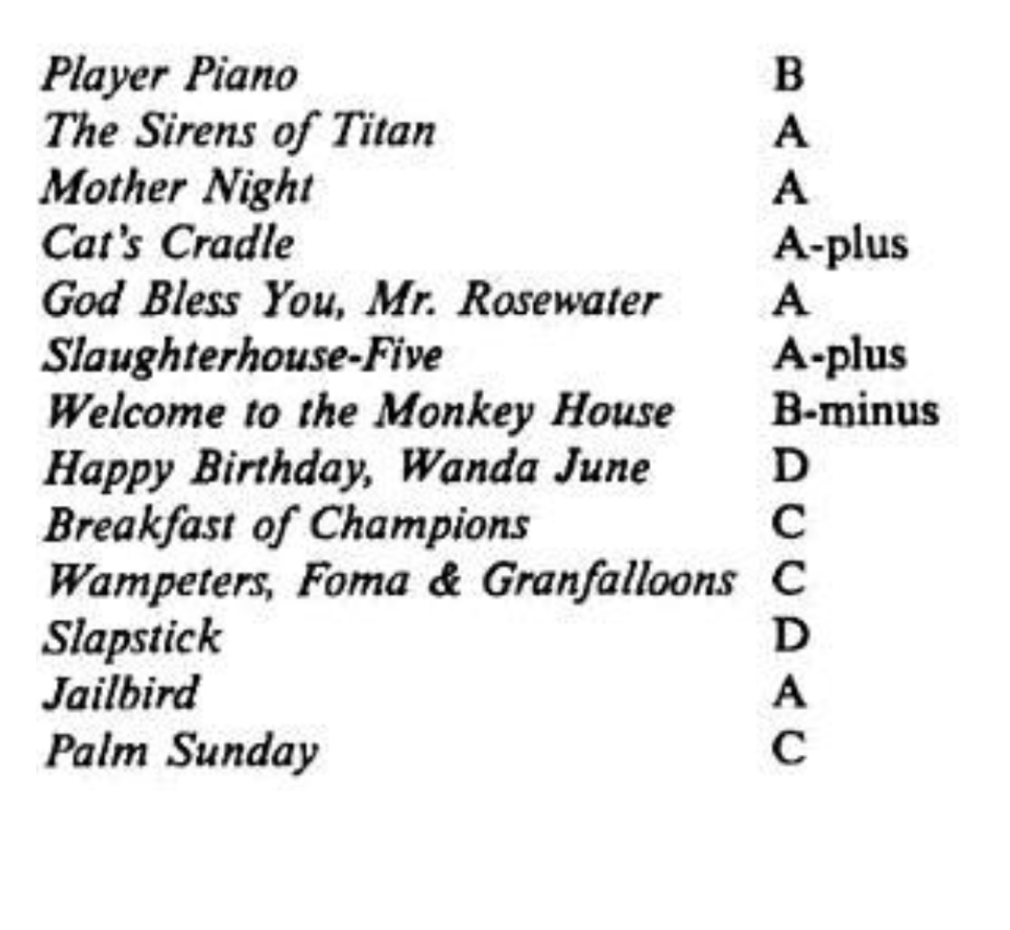
Steinbeck Journals, SJSU

Note: When I was pursuing my BA at San José State University, I enrolled in Steinbeck studies with Professor Susan Shillinglaw. John Steinbeck has been my favorite American author since I was ten years old, and I was incredibly fortunate to study with Professor Shillinglaw, who is one of the top Steinbeck scholars in the world. She was the director of the National Steinbeck Center in Salinas, California from 2015-2018; she was also the director of San José State’s Center for Steinbeck Studies for 18 years. She has published widely on Steinbeck’s work, including introductions to various Penguin Classics editions (Cannery Row among them); her own works include A Journey into Steinbeck’s California (2006) and Carol and John Steinbeck: Portrait of a Marriage (2013). I got so much out of the course, which was all-the-more significant because it was Professor Shillinglaw’s final semester teaching at SJSU. One of the ongoing assignments throughout the class was to keep a journal about our thoughts on the works we read, as well as the films based on Steinbeck’s work. Compiled here are my complete journal entries from the course, along with Professor Shillinglaw’s commentary in italics at the end of each entry. To say that I loved the class would be a serious understatement.

Casey Wickstrom
Collected Journals
Shillinglaw: Steinbeck 
SJSU Spring 2021

2/21/21—To a God Unknown

What struck me most while re-reading Steinbeck’s novel To a God Unknown was the depth of Eastern spirituality that the work exudes, as well as a blend of mythology, paganism, and various sects of Christianity and Catholicism. Reading the work again, a decade after I first discovered the novel, I was now taking in the story with a deeper appreciation of both writing style and spiritual understanding. As a result, To a God Unknown has now found its place among my favorite Steinbeck novels. The depiction of nature, Steinbeck’s strongest forte as a writer, creates some of his best passages in the book.

Ambitious and strange, Steinbeck’s novel describes his home landscape of Northern California—more specifically the San Antonio Valley—with a kind of depth and captivating clarity that only he can recreate. The way in which he examines the connection between man and the natural world that surrounds him offers a dark and fascinatingly rich study of Western theology, paganism, Greek mythology, and Eastern mysticism, all set against the landscape of the beautiful but foreboding San Antonio Valley. In A God Unknown, Steinbeck asks serious questions regarding life, meaning, and man’s role in the universe—but leaves all questions unanswered, open for interpretation, as he explores the land that readers would come to know so well in his work.

One of the best examples of Steinbeck’s masterful depiction of nature occurs early in the novel, when the protagonist Joseph Wayne finds himself in awe of both his new home in the Valley and his new love interest:

“The horses broke into a trot. Joseph saw how he could make a gesture with his arms and hands, that would sweep in and indicate and symbolize the ripe stars and the whole cup of the sky, the land, eddied with black trees, and the crested waves that were the mountains, an earth storm, frozen in the peak of its rushing, or stone breakers moving eastwards with infinite slowness” (Steinbeck). 

Not only is this passage masterfully descriptive, but through the lens of Eastern spirituality, the significance of the metaphorical waves of mountains offer an even deeper look into Steinbeck’s understanding of the intricate web of oneness that is found in all things. In gorgeous prose, Steinbeck describes the mountain ranges as “eddied with black trees . . . the crested waves that were the mountains, an earth storm, frozen in the peak of its rushing, or stone breakers moving eastwards with infinite slowness.” While this depiction of the mountains is profoundly poetic, we can unearth an even deeper message behind these words, perhaps deriving the author’s intention behind the passage. 

The mountains of the valley that Steinbeck describes are mammoth and of epic proportion; they appear unchanging in their harsh and forbidding terrain. Yet describing them as ocean waves, comparing them to water, the most constantly changing fluid matter, seems to contrast these two elements irreconcilably. However, if Steinbeck’s focus is to draw attention to the non-duality and interconnectedness of the natural world, then attributing the description of water to something as seemingly steadfast and unchanging as a mountain gives us an opportunity to recognize and consider nature’s constant impermanence. 

In truth, mountains are constantly changing, much like the ocean waves that Steinbeck conjures in their description. Consider the Grand Canyon—sculpted by eons of water and wind, the seemingly impermeable rock slowly and consistently worn down through the centuries, chiseled into unendingly deep canyons that continue to change moment by moment. The alteration of the mountains is perhaps imperceptible by man, but over the course of millions of years, such change is certainly undeniable. For Steinbeck to attribute the qualities of water to the mountain ranges of the San Antonio Valley may be more than just poetic license; the author may have written the description to intentionally demonstrate the ever-changing flow of the natural world; to depict earth and water as one, as elements that collide and synthesize, mixed also over time with wind and fire, in an infinite and never-ending collaboration that is always changing. 

Steinbeck has the ability, as all great authors do, to change the way that we see the natural world. If we read just a little bit deeper, beneath the lines of Steinbeck’s nature descriptions, we can see more than just gorgeous pastoral landscape painted with words. Suddenly, we can begin to see the world around as it truly is, acknowledging its state of interconnectedness and impermanence. And with this understanding, we too may begin to notice our own role in the ever-changing universe. 

Shillinglaw: Nice passage from the book--it does convey a sense of ecological holism, so important to the book. I like the way you connect that passage with Eastern spirituality. Wonderful insight--connection of earth and water. I've never thought about that passage in that way. 

2/24/21—The Long Valley

John Steinbeck is my favorite American author. He has been since I first read Of Mice and Men with my mother when I was ten years old, in fourth grade. I’ve read nearly all his fiction, with a few exceptions. To date, I’ve read 16 of his books. And out of all of those, my least favorite work of his is the collection of short stories in The Long Valley. I was twenty two when I read the collection and I remember feeling entirely underwhelmed by the majority of the stories. I had already read The Red Pony as a standalone novella, so that wasn’t part of the Long Valley reading experience for me. If it were my first time reading it, that may have redeemed the book significantly; The Red Pony is some of Steinbeck’s best writing. But instead, I became more and more confused as I read on.

I remember reading “The Chrysanthemums” and thinking, “Um . . . okay . . . so now what?” Even after reading it again as an older adult, and studying it at length in a Post Modern Lit class in Jr. College, after going over it again with an esteemed Steinbeck scholar at SJSU, I’m not impressed. There were moments of delicate beauty, to be sure, but not not enough to make it worth reading again.

Back at age 22, “The White Quail,” was an even worse read to me, and I started thinking, “Do I want to finish this book if all the stories are going to be like this?” It was just impossible for me to care about any of the characters—they seemed so thin and typical; they seemed to be the same people from story to story. And then I read “Flight,” and it turned things around for me. I thought, “Here we go—here’s the Steinbeck that I know and love.” The story of “Flight” is powerful and intense and beautiful, and, unfortunately, it’s the only story of its kind in the collection. The only other story that I was impressed by in The Long Valley was “The Murder.” The O. Henry writing award staff seemed to agree with my opinion. Again, having already read The Red Pony took away what may have been a positive influence in the overall reading of the book. Stories like “Johnny Bear” reminded me of early Vonnegut’s short stories (another favorite author, of whom I’ve read all his novels), but without any kind of real point to it. Other stories like “The Snake” and “The Harness” again featured characters that really didn’t speak to me on any level; they were so archetypical and redundant. I find it telling that, whether read at 22 years-old or 33 years-old (my current age), my feelings about The Long Valley haven’t changed. 

But here’s the thing: I love John Steinbeck. I’m glad that there’s stories of his that I don’t like; and I’m glad that I read them multiple times to definitively decide that they just don’t do it for me. It’s not that the writing itself is bad—the writing is strong and confident and enjoyable to read. I mean no disrespect to the writer or the instructor; it’s just that the stories simply don’t do it for me. Perhaps I’m subconsciously contrasting these short stories with the longer novels of Steinbeck: East of Eden; Grapes of Wrath; Tortilla Flat, and that’s why they seem lacking. Still, maybe the greatest benefit of reading The Long Valley is that it showed me what I like about Steinbeck stories, and what I don’t. And in realizing my personal preference in his writing, it gives me an even deeper appreciation of what I consider to be his stronger work.

Shillinglaw: Good, honest response. The stories are slices of life. He said of Chry, that the story should "strike without the reader's knowledge," which means, I think, that they should hit one so you have to think about what is happening or why it happened. That said, the characters aren't "round" in the way that some are. He's studying humans like a scientist--observing from the outside. Maybe that's why you don't like them. They are cool in tone, not emotional.

 2/22/21—Flight (film) 

The short film adaptation of John Steinbeck’s short story “Flight” was impressive in its cinematography and by staying so close to the source material. The casting and location were also a highlight for me, and the black and white color of the film seemed to add to the mood of the story. A few discrepancies exist between the book and the film adaption, some variations from the story that were perhaps necessary in order to move the story forward, and also to create a feeling of empathy with the character of Pepé. 

In the film, Pepé tells his mother that he killed a man while defending a working woman in a bar; in the book, no such background story exists. Pepé states in the story that a man merely “spoke words” to him and that his knife flew without any thinking of his part. This certainly makes it more difficult for the reader to empathize with Pepé, who appears more as a hothead than a chivalrous hero protecting a helpless woman from the violence of a brutish drunk. It’s obvious that this kind of background info and character development was added in to bring a more heroic element into the film, and help to make Pepé seem more likable.

Also, it is never specified in the written story as to who exactly is pursuing Pepé through the mountain terrain. As a reader, I assumed it was the law, or some extension of cowboy justice that tracks Pepé into the mountains and eventually kills him. In the film, it appears that the men hunting Pepé are vigilantes, avenging the death of their companion, whom they themselves don’t really care for. One man even states that it “was only a matter of time” before his “friend” met his end, acknowledging that his  companion’s behavior was out of line. Still, the crew seem to understand that, whether the death was deserved or not, their duty is to kill Pepé.

Another discrepancy between the film and the source material is the prevalent appearance of water in the film, something that the short story blatantly and intentionally lacks. In the movie version, Pepé stops multiple times to quench his thirst in a mountain stream. The original story deprives Pepé of any water during his flight—it even has Pepé going so far as to stuff his mouth with mud and suck on a rock. Indeed, the lack of water is arguably one of the greatest factors that accelerates Pepé’s demise. In the film, I suppose that the image of Pepé stretched out on the ground, his face dipped in a clean running stream, has a kind of dramatic effect; one that the condition of dehydration (on film, at least) would lack. 

Still, the main parts of the story were intact in the film: the family, the mountain lion, the death of Pepé’s horse and his complete lack of organization as he flees from the attackers. The cinematography throughout was remarkably spot on to this viewer; it was exactly as I saw it in my head. As I watched, I wondered if a color remake, recreated shot by shot, would be as hard hitting as the original. I doubt it; besides, the lack of John Steinbeck’s introduction would leave a void in the opening of the film.

The backstory of the film’s creation was as entertaining as the film itself to me. How a high school kid could blow $68,000 in 1960 and only have 5 minutes of footage to show for it is absolutely insane. According to Google, $68,000 in 1960 is equal to $602,457 in 2021. My hypothesis is that the kid either had a serious drug problem or owed a huge amount of money to some dangerous mobsters. Barnaby Conrad’s commentary at the end is both funny and insightful; what a life that man lived. All in all, both the film and the story surrounding it were fascinating and well worth the watch. The fact that it had John Steinbeck’s blessing and the author himself introducing the film made it all the more impressive.  

Shillinglaw: Yes, one assumes that he is pursued by vigilante justice. Good on water! And Pepe's thirst, like Joseph's, mirrors the region and shows his slow decline. Good on final paragraph commentary as well.

4/22/21—Tortilla Flat

I’ve read the majority of Steinbeck’s work, including nearly all the novels that we’ve covered in this course. Rereading it all again has been a luxury and total pleasure that has deepened my already vast appreciation for Steinbeck, who was and is my all-time favorite American author. I took this course with the intention of revisiting much of Steinbeck’s work that I had read over a decade ago, and generate a new and fresh perspective on his literary canon. This was my third time reading Tortilla Flat, and I feel like I’m reading it as yet another different, newer person. 

The first time I read the novel, I didn’t get it. I was twelve years old, too young, and I was confused at the story, which seemed to go nowhere. These men were just drunk all of the time; their actions and the story’s dialogue, the use of “thy, thou art,” struck me as weird. When Danny’s house burned for the first time, I couldn’t understand why he was happy about it. Having read Of Mice and Men, the narrative style of Tortilla Flat seemed to contrast sharply with the characters and events that I had been familiarized with. It was a break in literary style from the Steinbeck that I knew.

And then I read it again, at twenty two years old, and it became one of my favorite Steinbeck books. The story of friendship, the camaraderie, the conquests, the sacrifices and the drinking, the drinking, the DRINKING. It all resonated with me so deeply, and it became the inspiration for my own writing at the time—a novella based on my life at age nineteen, living in a house for a year with my closest friends, all of us on our own, with no restrictions, completely free. The amount of alcohol and drugs that we abused during that year was ungodly; it was a year of complete decadence and debauchery and destruction and unrestrained youth. And yet the beauty and freedom of that time has stayed with me forever; the depth of friendship and the hours of conversations and the brotherly love and care that we had for each other mirrored the love of Danny and his friends. Steinbeck’s depiction of brotherhood in Tortilla Flat and the masterful descriptions of nature in his writing were the inspiration for my own memoir:

Excerpt from A Tragedy of Youth

It seemed unreal to me, as the end of June rolled around, that we had been in the house for nearly a year. Many was the time when I thought it would never end. Sitting in the living room with my friends, all the summer parties; then the fall when the trees turned red and orange and yellow like natural fireworks; then winter, when the the snow piled up outside our house, the cheap liquor filling our bodies with superficial warmth; the nights of brotherhood, just talking, talking, talking, time seemed to stand still. And yet here we were.

I thought of all the beer boxes and cans piled up in the kitchen. I thought of all the cocaine, the drugs, the fights, I thought of the broken window and the parties. I thought of all the times I’d thrown up into the toilet, all the times that I had made myself sick. I thought of the love, the friendship, all the time we had spent right in this living room. Suddenly, I felt very old and tired.

. . .

To me, the influence of Steinbeck’s writing on my own work seems almost too obvious. Appropriately enough, the book’s inception was fully inspired by Tortilla Flat. The novel laid the foundation for my own storytelling: to take something as seemingly banal as drunk friendship and portray it in a light of epic grandeur was something that I could fully embrace.

Now, the third time reading Tortilla Flat, at age thirty-three, I’ve been clean for over half a decade. Drugs and alcohol and self-destruction are no longer the focal point of my existence. Yet Danny and all his friends are still there in Tortilla Flat, drunk and disorderly, loving and loyal in their own specific way. It occurs to me now that Steinbeck’s narrative approach to Tortilla Flat could easily have been a long joke at the expense of its characters: the drunken antics of shiftless paisanos as they stumble in and out of trouble, all for a laugh. But Steinbeck chose to write with sincerity, with an authenticity that brought out the beauty of brotherhood and friendship. And it’s that sincere depiction of love among friends that still captures my own imagination.

Shillinglaw: There is a book by Anne Fadiman called “Rereadings." And there is, as you say, distinct pleasure in rereading a book you love. How much of your memoir have you completed? And the drink is not, as I noted in class, an end in itself--at least in Steinbeck's mind. I think it's the friendship that remains...

4/22/21—Of Mice and Men

This is my fourth time reading Steinbeck’s American classic Of Mice and Men, and much like his other works, my appreciation for the story increases with multiple readings. I noticed many new things this time around, having to do with the literary elements that Steinbeck utilizes. For instance, the novel begins and ends at exactly the same spot: by the creek, in a hideaway, where George and Lenny find themselves in a familiar predicament involving a woman and a posse of angry men pursuing them, out for Lenny’s blood. This full circle narrative is masterful, and everything up to the final conclusion is constructed perfectly in foreshadowing and metaphors. 

Carlson’s gun is used to kill Candy’s dog, with a shot right in the back of the head. The same gun is used later on to kill Lenny; George shoots his friend in exactly the same spot. Curly’s wife—whom I never realized remains nameless throughout the entire story—is instantly bad news. Lenny’s habit of killing whatever he touches  (mice, puppies) certainly foreshadows his killing of Curly’s wife. The use of hands in the story speaks volumes to the reader: George’s tough hands, Lenny’s huge paws, Curly’s soft, vaseline gloved hand, Candy’s stump . . . These men all live through their hands.

The pathos and ethos of the story is so rich and deep; the unlikely bond of George and Lenny has been an iconic symbol of friendship since the novel’s publication. The novel’s tragedy is in its humanity, in its broken dreams and unrealized hopes and goals. But what was perhaps the greatest takeaway from me this time around was just how quickly the story moves. I hadn’t realized that the whole story takes place in a matter of days—two days or so, from beginning to end. This timeline moves along quickly, the pace is steady and intentionally focused. I suppose that in the past, the amount of time taken to read the book was spaced out over a much longer period (ie a month in high school curriculum), which surely made the book feel like it takes place over a longer period of time. Reading the book in two sittings, I read it as more of a play, each chapter was an act. This was an intentional approach of Steinbeck’s, in a style that was fully realized in his odd work Burning Bright. Of Mice and Men is the better work, and packs a lot into one hundred pages.

The novel has been made into several film adaptations and has also made its way onto the stage as a Broadway play. For my money, the best version of the film is the 1992 picture starring Gary Sinice and John Malkovich. The 1939 black and white film is done well, but it’s too overly dramatic for me; the actors all project themselves like they’re on stage, which leaves little room for subtlety and emotional nuance. Many of these older films sound like the characters are shouting while reading off of cue cards.

Sinice manages to capture the pathos of the novel in his film; there’s a beauty and a controlled flow of direction that is  absolutely masterful. Sinice’s role as George Milton is pitch perfect, and John Malkovich delivers the definitive role of Lenny. The emotional bond and the vulnerability between ranch hands is both tender and heartbreaking. The scene of Lenny crushing Curley’s hand is so well done; it’s powerful and gets me every time. The end of the film always leaves me choked up. It captures the mood and tone of the novel perfectly.

Gary Sinice is a huge Steinbeck fan: not only did he direct and produce the film adaptation for Of Mice and Men (for which he was nominated for the Palm d’Or at the Cannes film festival)but he also narrated the audiobook of the novel, which I listened to as a kid after reading the book and watching the movie (it’s worth noting that Sinice also narrated Steinbeck’s Travels with Charley in Search of America). He also starred as Tom Joad in the play adaptation of Grapes of Wrath, where he received a Tony award nomination for Best Actor. It’s nice to see an actor that appreciates Steinbeck’s work so much, and who is also able to do justice to some of the author’s best known stories.

Shillinglaw: Mice is a wonder, I agree. It's tight, claustrophobic, so that you feel how constrained the lives of Lennie and George are. The gun is a Lugar, and there are some interesting critical articles about eugenics and Mice (although I'm not sure I agree with the premise--see Louis Owens' article on Mice--I tried to find a copy, but don't think I have it scanned. So I attached another that is good). I like what you said about reading the book in HS, over weeks. Sometimes it's easy to lose the impact that way, for all books. I do like the George of 1939...and I don't like the too-abrupt ending of 1992. Gary Sinise was also in the Steppenwolf production of Grapes, a superb drama.

4/22/21—The Grapes of Wrath: A Modern Reflection

When I first read Steinbeck’s The Grapes of Wrath, I was twenty two years old and the US was in the middle of the great recession. In many ways, this time period mirrored the novel’s Great Depression era of the 1930’s, though fortunately not in severity. As a broke twenty-something living in Boulder, Colorado, I was virtually untouched by the 2008 recession. I’d never had much to lose to begin with, so hearing of other people losing their jobs and homes because of the bursted bubble of the economy meant very little to me. Bailouts of Wall Street and the real estate market and the auto industry seemed too abstract to me (in fact, they still do). However, it was interesting to observe the historical significance of being in a recession; and I was also able to take in the changing winds of politics at the time: Barack Obama was running for president, and the sociopolitical pendulum of the United States was swinging from right to left. Obama’s message of hope and unity seemed to offer Americans a kind of light at the end of the tunnel. Reading The Grapes of Wrath at this time offered a unique perspective on America during the Great Depression, while simultaneously mirroring the relevant and parallel struggle of Americans in the fallout of the Great Recession. The story of the Joad family making the passage from Oklahoma to California, and the reception upon their arrival, was bleak and sad and angering; the novel reflected many of the sentiments that I’d heard on the news following the 2008 recession.

Now I’ve read The Grapes of Wrath again, at age thirty three, in the wake of the coronavirus. The US and much of the world is still reeling from this deadly pandemic; it’s been an entire year that will leave its mark in history forever. In the fallout of the coronavirus, the US economy is is shambles. California, the first state in the nation to shelter in place, has been hit hard, with significant unemployment spikes and a meteoric rise in homelessness. The wealth gap in the US has exponentially increased: capitalism has worked well with the richest .01%, while middle class unemployment and poverty levels continue to skyrocket. It seems that 2020 brought the themes of Steinbeck’s The Grapes of Wrath squarely back into focus, marking an ever deeper relevance than possibly ever before. Themes of American displacement, destitution, class struggle, social unrest, and hope in the midst of hopelessness, the novel’s story is more relevant today than at any other time since perhaps the Great Depression in which the book takes place.

Steinbeck’s scope of the novel is wide and deep, written on a nearly biblical scale. The trek of the Joad family from the dustbowl of Oklahoma to the promised land of California depicts the struggles of millions of Americans. The destitution of America’s own people in the midst of the Great Depression was shockingly appalling; the level of poverty and desperation that the novel portrays is fortunately beyond any level of comprehension for me. The resiliency of the Joad family encapsulates the resiliency of humanity; the struggle of the poor and downtrodden in the novel shows us that even in the darkest and most hopeless circumstances, there is compassion and kindness to be found. 

Thanks to the myriad socioeconomic programs following the Great Depression, many of the fundamental problems of the novel have been addressed. Unionization, worker’s rights, unemployment benefits, regulation of banks, and other social welfare efforts have set up a buffer against another Great Depression. Time will tell if these programs are enough to revive America post-COVID. Like many of the socioeconomic dilemmas illustrated in The Grapes of Wrath, I think we still have a long way to go.

Shillinglaw: I guess we have to hear/confront again the issue of poverty in America. The book is always, it seems to me, relevant in a new way. And I guess that shows that we’re cycling through episodes of loss and displacement and powerlessness for many. 

4/22/21—The Grapes of Wrath (film)

As someone who loves literature and American film, I’m surprised that I hadn’t seen John Ford’s The Grapes of Wrath. It’s widely regarded as one of the greatest films ever made, and the source material from which it was derived has long been lauded as the quintessential American novel. After rereading Steinbeck’s The Grapes of Wrath, I was excited to see the 1940  film adaptation, and I was not disappointed. The critical praise of the film is certainly warranted; and while I truly appreciated the aesthetic and artistic accomplishment of the film, I found there were many elements of the novel that were sorely missed. Reading up on the movie trivia after streaming the film on Amazon, I was able to derive a deeper sense of the film’s history and creation, while contrasting and contextualizing such details with the novel.

The first half of the film is so true to John Steinbeck’s novel that I found myself in awe of just how perfectly it had been done. Henry Fonda as Tom Joad was a captivating performance; Steinbeck himself said that Fonda’s role “made me believe my own words.” The way that the film incorporates the story of Muley Graves, detailing the land takeover by the banks during the dustbowl, made it emotional and rich through the use of flashbacks and narrative storytelling. It was a masterful portrayal of some of the novel’s most powerful imagery, and set a strong foundation for the rest of the film. The second half of the film started to deviate from the novel in many ways. While it’s understandable that no film based on a novel can perfectly convey everything in the book, it’s worth detailing how the latter part of the film lacked many of the elements that made made the novel great. 

The novel’s brash, uncensored, and often vulgar dialogue is one of the many sources of controversy surrounding the work; as are the political overtones and criticism of the socioeconomic conditions of America in the Great Depression era. Many of these aspects were, not surprisingly, left out of the film. Given the language restrictions of Hollywood at the time, it would be unthinkable for any mainstream film to feature the kind of language and conversations that made the book so effective in its portrayal of American realism. According to the film’s trivia, Henry Fonda yelling at his mother to “get the hell off the car” in one scene was barely audible, and would have resulted in censorship had it been more audible.

John Ford’s direction was confident and assured—a staunch conservative, he was seen at first as a surprising choice of direction. Ford chose to downplay the political tones of the novel and focus instead on the family unit of the Joads. This approach is nicely summed up in the film’s section where someone asks a farmer “What’s a red?” In the novel, a character states that “‘A red is any son-of-a-bitch that wants thirty cents an hour when we're payin' twenty-five! . . . Well, Jesus, Mr. Hines, I ain't a son-of-a-bitch but if that's what a red is—why, I want thirty cents an hour. Every'body does. Hell, Mr. Hines, we're all reds” (Steinbeck). In the film, when asked the same question, the farmer responds by saying “Well, I don’t know about it one way or the other.” Such a dismissal is indicative of the film’s reluctance to take on Steinbeck’s strong criticism of capitalism.

The second half of the movie turns very Hollywood, which is warranted. I certainly wasn’t expecting full frontal nudity with Rose of Sharon breastfeeding a dying old man—indeed, while it’s the closing scene of the novel, such a scene never takes place in the film. Rosasharn loses her baby in the novel; no such occurrence takes place in the film. Instead, the film ends on a positive note, with Ma Joad’s inspirational monologue as the family, sans Tom, pulls into a clean and well kept government camp. The ending of the novel is starkly different, and ends at the lowest point for the Joads: they’re flooded out of their boxcar makeshift house, the car dies and they end up in an abandoned barn, wet and filthy like animals. Such an ending in the film would be unthinkable, even by today’s cinematic standards (short of an indie art film interpretation of the novel, perhaps). Steinbeck's novel simply has too much depth and realism to be translated completely to the medium of film, but the film did manage to retain many of the novel’s inspirational themes of family and community, and certainly did well at depicting the struggle of so many Americans during the Great Depression. It definitely did the book justice, which is the highest accolade that can be given to any movie based on a novel.

Shillinglaw: Good on first part of novel--yes, Ford was determined to capture a sense of poverty. The latter part of the film, the arc upward, was determined by audience expectations. Actual novel too dark for 1930s sensibilities, it was throughout. Excellent points. Glad you saw the film. Fonda is superb. Wonderful notebook, fun to read.

5/18/21—Cannery Row

The first time I read Cannery Row, it was my least favorite Steinbeck novel. Immediately after, I read the book’s sequel, Sweet Thursday, and that book instantly garnered the title of Steinbeck’s worst book (in this reader’s humble opinion). In retrospect, there’s a lot that I didn’t know about the background history of Cannery Row that may have given me a deeper appreciation of the novel. I had no idea who Ed Ricketts was—I actually had never heard of him until this course! Reading the appendix from Steinbeck’s The Log from the Sea Of Cortez, the author reflects on his friendship with Ricketts, and notes the influence that Ed had not only on Steinbeck, but on everyone that he met and interacted with. My journal entry regarding Sea of Cortez is independent of this writing, so I’ll stick with my analysis of Cannery Row to avoid repetition. The point is that I had no idea that the character of Doc was modeled after Ed Ricketts (as was Jim Casy, Doc Burton, Doctor Winter, and other Steinbeck characters). Had I known of Ricketts and his personality, it would have added a much appreciated layer of depth and context to the story.

Reading Cannery Row for the second time, I was now aware of Ricketts’ influence on the novel: his intellectual, philosophical, and scientific proclivities, to name a few of his characteristics. All that being taken into consideration, I’m still not a fan of the book. It’s a light, harmless read. To me, Steinbeck is playing it safe and writing on what feels like autopilot. The book doesn’t challenge me in any way. I’ve read the characters before in better stories: Mack and the boys, who inhabit the Palace Flophouse in Cannery Row, are nearly identical to Danny and company in Tortilla Flat, including their penchant for unemployment, drinking, and throwing parties that destroy houses (or laboratories). I enjoyed the escapades and conquests of Tortilla Flat’s paisanos much more. The build up and climax of Cannery Row is that the townsfolk arrange and throw a party for Doc—it all seems to end abruptly, and on a dull, anticlimactic note.

I found the introduction of the book to be the most illuminating part of the reading. In many ways, it clarified and confirmed some of my sentiments on the novel. Shillinglaw states that, “From its very inception, the Monterey material was one antidote to the highly political and politicized novel The Grapes of Wrath.” Dealing with ill health and a deteriorating marriage, as well as the controversial acclaim following Grapes of Wrath, Steinbeck was left feeling “a desperate need to escape from fiction, to kick up his heels instead.” This explains the drastic shift in literary tone and subject matter that Steinbeck channeled in Cannery Row. 

So, while I feel that the novel is indeed “frothy, sentimental,” and “an arbitrary sequence of trivial events,” it’s encouraging to know that in some ways, those views are valid. Steinbeck himself dismissed the novel as “a nostalgic thing, written for a group of soldiers who had said to me, ‘Write something funny that isn’t about the war.’” It’s nice to know that Steinbeck sees where I’m coming from on this. I can appreciate Cannery Row, and I’m glad that I read it again—but it’s still a book that ranks low on my list of Steinbeck’s best novels. 

Quick aside: seldom is the opportunity that I can quote the introduction of a novel to the very author who wrote said introduction. Very cool. Truly, the intro really enhanced my understanding of the novel’s themes and more nuanced elements: the gopher metaphor in particular was very effective, as was the exploration of certain characters and the geographical significance surrounding the novel. It gave me a much deeper understanding of what could be found in the book. Thank you. 

Shillinglaw: Yes, CR is a tribute to Ricketts and his way of moving through the world. I hope I convinced you--just a bit--that CR is complex once you consider its 4 layers...Yes, CR is funny--but also nostalgic and sad. Thanks for your nice comments about intro.  Nice of you to read it (!) and comment!

5/18/21—The Log from the Sea of Cortez

As I stated in my analysis of Cannery Row, I had no idea who Ed Ricketts was before taking this course on Steinbeck. I love Steinbeck’s work, and I was certainly familiar with Joseph Campbell’s literary and philosophical work as well—Hero’s Journey; The Hero with a Thousand Faces, etc. But I’m a little surprised that I missed out on Ricketts, whose influence on both authors, and countless others, is hard to overstate. In the appendix of The Log from the Sea of Cortez, Steinbeck gives his friend a beautiful eulogy, examining the myriad contradictions and the eccentricities of his brilliantly complex and fascinating companion. Steinbeck writes with a kind of love and admiration of Ricketts that’s as personal as it is honest. I’ve never read Steinbeck like this before: so relaxed, so comfortable, so reflective and open. It’s a completely different tone. His writing on Ricketts is warm and intimate, with a kind of effortless flow that shines a complicated but endearing light on one of his closest friends.

Steinbeck opens his writing on Ricketts with a jarring introduction, beginning with Ricketts’ death. On May 11th, 1948, Ricketts was hit by a train while driving in his car; he hung on for three days, conscious some of the time, before he finally died. This was a bold and deeply compelling artistic move for Steinbeck to make: to start with Ed’s death is to examine the man in retrospect, after he was no longer alive. It sets a very specific tone to the writing: the introduction and indeed the entire text would have been quite different if Steinbeck had ended the writing with Ed’s death. Instead, I felt like I was also broadsided by a train as I read the beginning of the story. Ricketts' untimely death was sudden and absolutely unexpected. The could be many reasons Steinbeck's choice of narration. Perhaps Steinbeck is showing us that Ricketts was, above all else, human, a mortal man just like any other. He was complicated and multi-dimensional, and no one, not even Steinbeck, knew him completely. 

Steinbeck’s honest portrayal of Ricketts does not deify him; it doesn’t need to. Ricketts’ life was full of depth: science, philosophy, art, music, literature, adventure, romance, friendship . . . He was unapologetically real; his authenticity was perhaps his greatest asset. This is the friend that Steinbeck examines, while admitting that it is only one view of a deeply complex person. Still, the Ricketts that Steinbeck knew is immortalized in much of his work, perhaps nowhere more than Cannery Row and the book's sequel Sweet Thursday. There are gems of Ed Ricketts in Cannery Row; you can almost hear the words coming from the man himself. 

One passage that struck me came from Cannery Row; a philosophical monologue from Doc that seemed timely, relevant, deep and honest. To me, it’s the best passage of the book: 

“It has always seemed strange to me," said Doc. "The things we admire in men, kindness and generosity, openness, honesty, understanding and feeling are the concomitants of failure in our system. And those traits we detest, sharpness, greed, acquisitiveness, meanness, egotism and self-interest are the traits of success. And while men admire the quality of the first they love the produce of the second” (Steinbeck). 

No one knew Ricketts completely. But I’d say that, in Steinbeck’s writing, the voice and legacy of his dearest friend is in good hands. 

Shillinglaw: You do a nice job of describing the tone in "About Ed Ricketts." Yes, there was love between the two men--an intense friendship. I love the fact that Steinbeck captures Ricketts through paradox--and you're right, he doesn't try to deify him.

Great quote "things we admire in men..." so true.

5/4/21— East of Eden

East of Eden is my favorite book by my favorite American author. The multi-generational storyline is magnificent in its scope, and the biblical narrative interwoven into the novel’s 600 pages is profound and powerful. There is so much beauty in the novel, so much depth and love and humanity. It’s one of those books that changed my life. I had always known that Steinbeck considered East of Eden as his magnum opus; it was the novel that he put every ounce of himself into. His letters to his editor in Journal of a Novel corroborate this conviction tenfold. As the author noted in one of his letters: 

“I have often thought that [East of Eden] might be my last book. I don’t really mean that because I will be writing books until I die. But I want to write this one as though it were my last book. Maybe I believe that every book should be written that way. I think I mean that. It is the ideal. And I have done just the opposite. I have written each book as an exercise, as a practice for the one to come. And this is the one to come. There is nothing beyond this book—nothing follows it. It must contain all in the world I know and it must have everything in it of which I am capable—all styles, all techniques, all poetry—and it must have in it a great deal of laughter” (Steinbeck, Journey of a Novel 8).

While reading Steinbeck’s lettersI was continually taken aback at how much it resonated with my own beliefs on art and writing and philosophy and the creative process. There were beliefs and ideas in the letters that I had only recently started to explore in my own life; through meditation and writing and self-inquiry, it seemed like everything had started to connect at exactly the right moment. The parallels between Steinbeck’s thoughts and my own were more than coincidental. This is why I decided to purchase the signed first edition of Steinbeck’s best novel. The decision was a culmination of so many driving factors: emotional, intellectual, and spiritual. It’s not hyperbolic when I say that I really felt the universe pushing me towards buying this book. It was $2,725. And it is one of the greatest things I’ll ever own. Reading the novel again after a decade, I fully recognize that East of Eden is more than just a book to me; it’s an integral part of who am I.

. . . 

All that being said about the novel, I have to change my tone and admit that I absolutely hated the film. It was a complete and utter abomination to me; the acting and the writing and the casting were atrocious. It was painful to watch—torturous, even. I don’t care how much Steinbeck liked it; in my opinion the film lacked literally everything that made the book great. My dislike for the film was so strong that I had to wait a day after watching it before writing this entry; I didn’t want it to be too vicious. I’m looking forward to hearing what others think of the film; but as for me, my disappointment is probably too great to change my mind on the subject.

Shillinglaw: Wow. This is very powerful . . . a wonderful statement to Steinbeck's power. Thank you.

And it's ok if you hated the film. I understand. 

5/11/21—Travels with Charley: In Search of America

I like Travels with Charley. It’s not Steinbeck’s best book, and certainly not my favorite, but it’s a nice and honest take on a country that had grown foreign to Steinbeck in his later years. The irony of one of America’s greatest writers feeling like a stranger in his own land is at the heart of the book. Steinbeck doesn’t recognize the America that he is traversing: many of the landscapes and the people and the world around him have changed so drastically that he is experiencing a completely different country than the one he remembers, the one he spent so much time studying and depicting in his younger years.

The book is a lighter read than many of Steinbeck's heavier, longer fiction novels. Travels with Charley is fast paced and a bit rushed, not in it’s writing but in its narrative structure. There is a constant motion, a persistent pushing, rambling trajectory that’s driving Steinbeck on. Steinbeck spends time on the road, taking notes on social interactions (or lack thereof with townsfolk, truckers, and easterners); he writes sparingly about politics (nobody’s talking openly about it), about weapons of war (a conversation with a submarine soldier on leave) and life in small towns throughout the country. He notices the similarities and points out what has changed, at least in his mind.

At times, Steinbeck seems a bit crotchety and old, like a bewildered senior citizen flabbergasted and confused at the strange contraptions of a world that had moved on without him. The writer is shocked at soup and coffee that is automatically dispersed from machines with no human interaction. He openly moralizes much more than in many of his other works—explicit moralization as opposed to implicit. It’s a bit like reading the journals of someone’s grandfather, who keeps repeating, “Back in my day . . .” As a twenty-first century American, I find myself smiling at Steinbeck’s weary depiction of the more “modern” United States of America. Given the current age of the internet, social media, and everything therein, various flavors of soup dispensing from a can sounds downright antiquated and primitive. But to be fair, Steinbeck is older: Travels with Charley was his last book before his death in 1968, not counting the collection of essays compiled in his final work America and Americans, which took on many similar themes. The title is “in search of America”—not “finding America” or “rediscovering America.” The author’s search at times seems to leave him more estranged from the country than at the beginning of his journey.   

Steinbeck’s voice is strong; he has his trademark wit and masterful prose and writing style; there are many beautiful and insightful passages and sentiments throughout the novel. Some personal favorites of mine are in the first half of the book. Steinbeck, in describing his old age and his refusal to fall into the trap of old-age complacency, states, “I have always lived violently, drunk hugely, eaten too much or not at all, slept around the clock or missed two nights of sleeping, worked too hard and too long in glory, or slobbed for a time in utter laziness. I've lifted, pulled, chopped, climbed, made love with joy and taken my hangovers as a consequence, not as a punishment.” Living life to the fullest is strongly characteristic of Steinbeck, who insists that he’d rather go out swinging than fade away in the comfort of senility. “I see too many men delay their exits with a sickly slow reluctance to leave the stage. It's bad theater as well as bad living.” Other gems are: “I was born lost and take no pleasure in being found,” and, in describing the myriad contrasting points of view not only with various writers but in one’s own eyes: “So much there is to see, but our morning eyes describe a different world than do our afternoon eyes, and surely our wearied evening eyes can report only a weary evening world.”

Steinbeck's choice to take Charley as his companion was a great move; the novel would have been so different if he had gone it alone, or with anyone else besides his French poodle. I feel that there would be a feeling of brooding loneliness permeating the novel had Charley not been along for the ride. The book shows the beauty and the ugliness of America—choosing to end the book around his time in New Orleans depicted racism, ignorance, and violent hatred in such extremes that it makes me sick to read. Steinbeck abhors this, and the way he writes makes his disdain almost palpable. The author’s depiction and views on racism is deeply important in the latter part of the novel; it shows the dark side of America that many authors of Steinbeck’s generation didn’t notice or consider examining. Travels with Charley is an older book from an older time, but in many ways it shows a timeless picture of America that, for better and for worse, is familiar in so many ways.

Shillinglaw: I think Travels represents the two sides of Steinbeck--restless and rooted. Steinbeck is 58 when he takes this trip, not so very old. But age is a state of mind, and I think he feels old after his brush with death the year before. Yours is a very fair analysis of the book.

5/16/21—Lifeboat (film)

A collaboration between Alfred Hitchcock and John Steinbeck sounded amazing to me; I’m a fan of both men and their respective mediums of art, and strangely, I had never even heard of Lifeboat. Directed by Alfred Hitchcock, and based on a story by John Steinbeck, the entire film takes place on a small claustrophobic lifeboat during World War II, with an eclectic crew of passengers that vary widely: sailors, a nurse, a journalist—and a German U-Boat captain, also rescued from the wreckage. The Americans take the German aboard, their reservations ranging from doubt to open mindedness to outright malice and distrust. Still, in the emergency situation, the Americans decide to keep the German on board with them until they can find help or reach land. What follows is a tense and violent drama that takes on the themes of war, duty, trust, and humanity.

While the cast of characters is impressively diverse, the German is easily the most complex role in the film. For most of the film we are unsure of his motives: at times he appears benevolent, willing to help: he offers direction, amputates the gangrene infected leg of a passenger, and spends much of his time rowing the boat while the rest of the crew rest. Yet his actions also prove untrustworthy: he hoards a compass, he hides water and food pills, he pushes a dying American overboard. In the end, the crew turns on him, beating him unconscious and throwing him overboard, in what amounts to an execution. The complexity of the German character generated a strong amount of negative press: critics felt like the film humanized the German instead of villainizing  him; Hitchcock was accused of sympathizing with the Germans, and the backlash prompted limited release for the film and very little support from the studio.

Steinbeck also took issue with the film, stating that the role of the black passenger fell victim to stereotyping, becoming a surface level archetype of race, and was not portrayed accurately from the source material. Steinbeck denounced his role in the film and asked to be removed from the credits; instead, his name was placed front and center and he was nominated for best story at the Academy Awards. When I read these facts this prior to watching the film, I had expected to see a racist portrayal of the black character George: talking in obvious ebonics, shucking and jiving, playing a servile role with a lot of “yes ma’am, no ma’am.” To tell the truth, I was actually quite impressed with the character; I didn’t feel like he was stereotyped or disparaged at all. On the contrary, I felt that he was one of the stronger characters in the film. While I can’t fault Steinbeck for wanting to portray the black character with more depth and humanity, I think that Hitchcock did a fantastic job with all the characters—especially the token black character George, aka “Joe.”

Steinbeck had also faced past criticism for portraying German characters in a potentially sympathizing light: his novella The Moon is Down created a story with characters that were not clearly distinguishable as purely good or evil. This nuanced characterization angered many critics who were perhaps looking for pure jingoistic propaganda. But both works, The Moon is Down and Lifeboat, are excellent because they challenge us as readers and viewers, forcing us to examine all the characters in their complexities, where obvious labels of "good" and "bad" don’t suffice. While it’s admittedly much easier to label each and every German character as the pure embodiment of evil, and every American as the perfect and admirable hero, war—and real life—aren’t that easily distinguishable. The dichotomous thinking of black or white, good or bad, all-or-nothing is easier, but it is woefully ignorant, deceptively comfortable, and deprives us of understanding and progress. Steinbeck and Hitchcock understood this; in telling their stories, they didn’t take the easy way out in exchange for obvious answers. They challenged their audience. And Lifeboat is a far better film because of it.

Shillinglaw: Great comments about the film and complexity of the German. Wonderful conclusion here. Casey, your notebook was a pleasure to read. I loved how you dug into each text; your appreciation of Steinbeck's work was palpable. A+ Notebook
Beowulf and Aquatic Monsters: A Word Study

This word study was written for an English class at SJSU.

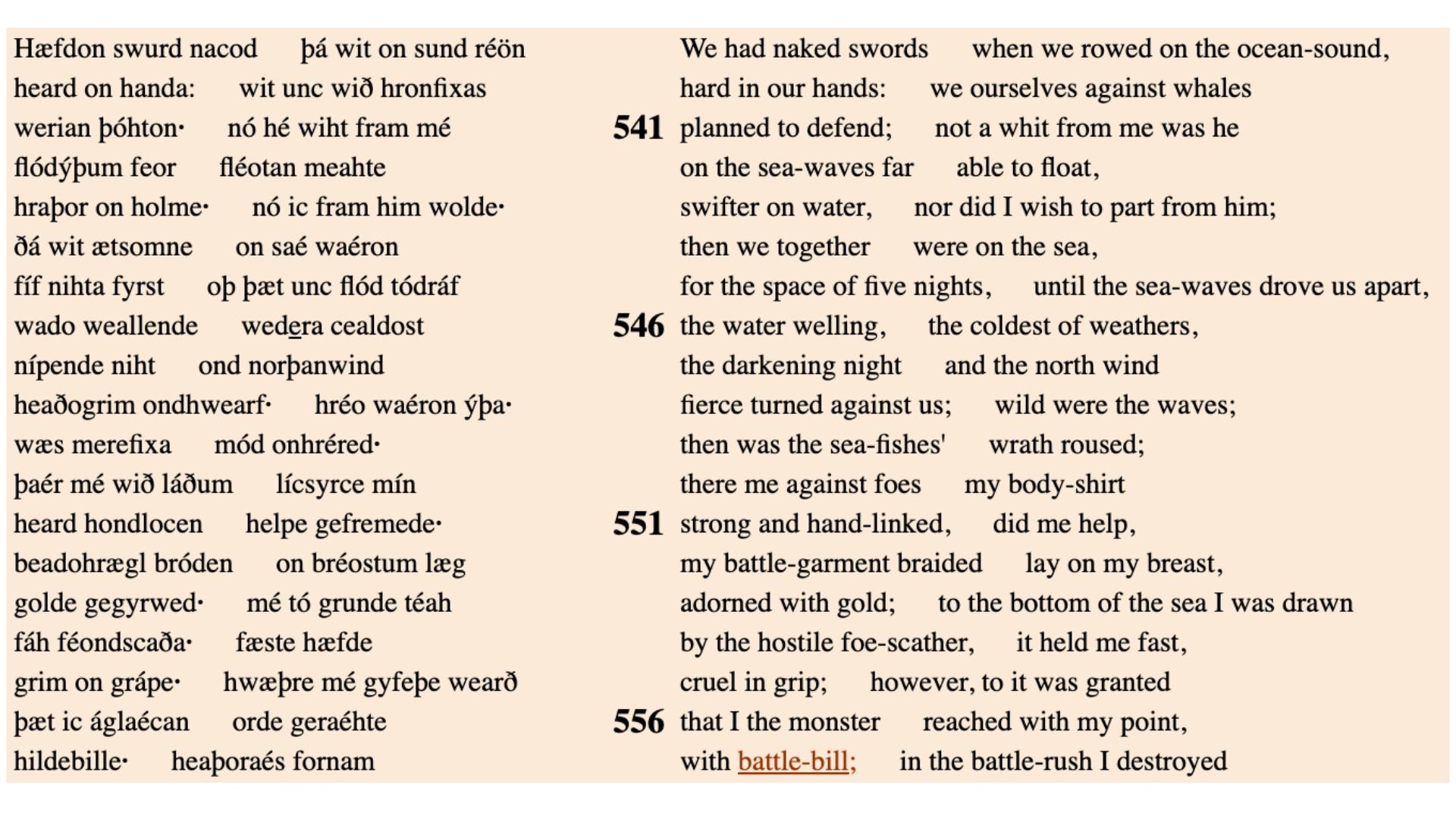
Beowulf is an Old English epic poem written approximately between the 8th and 11th century. Consisting of 3,182 alliterative lines, the poem chronicles the adventures of the Germanic hero Beowulf and his violent conquests over armies and monsters. Beowulf is considered to be one of the most important and well known works of Anglo Saxon literature, and continues to be one of the most translated texts of all time. The poem incorporates many different chronological and historical narrative timelines throughout, often told through character dialogue, and mainly expressed through the use of dramatic monologues. One such memorable monologue occurs upon Beowulf’s arrival to Heorot, a royal mead hall, where he and his army of Geats are invited by the Danish lord Hrothgar to drink and socialize. In the hall, Beowulf vows to destroy the creature Grendel, who has terrorized and slaughtered the hall’s inhabitants. After swearing to defend Heorot, Beowulf is then taunted by Unferth, a drunk and jealous thegn of Hrothgar, who claims that Beowulf lost a swimming match with his childhood friend Breca, when both men swam out into the icy ocean and stayed for seven nights, with Breca finally besting Beowulf after making it ashore first. Unferth publicly questions Beowulf’s ability to defeat Grendel when he can’t even win a swimming match between boyhood friends. Unperturbed by Unferth’s personal attack, Beowulf calmly and confidently recounts his harrowing oceanic experience in a fantastic monologue that offers an Anglo Saxon exploration of various aquatic sea-monsters. Benjamin Slade’s 2012 diacritically-marked text and facing translation offers an accurate and expert rendering of Beowulf’s tale:


All told, Beowulf claims to have killed nine sea monsters during the seven nights spent swimming in the Northern ocean, while wearing full armor and carrying only a “naked sword.” Within this monologue excerpt alone, the reader encounters the vivid descriptions of five marine creatures: “Whales; Sea-fishes; Hostile foe-scather; Monster; and Mighty sea-beast” are all words that Slade has translated from the original Old English text. By examining all five terms and referencing the Bosworth Toller Anglo Saxon Dictionary, as well as breaking down many of the words into smaller linguistic components, we can gain a deeper grasp on the language and definitions behind these underwater monsters. 

The Anglo Saxon word “hronfixas” is the plural of the kenning (or Old English cognate) “hran-fisc,” which translates literally as “whales.” Once separated into two words, one can immediately connect the word “fisc” to the modern English word “fish.” The word “fisc” appears again in the next term, “merefixa,” a plural of the Anglo Saxon kenning “mere-fisc,” or “sea-fish.” This cognate of “mere-fisc,” when broken up, is again quite familiar and easily recognizable from a linguistic standpoint. Those with any knowledge of the Latin romance languages can see the commonality between the word “mere” and the Latin word for sea: in Spanish, the word for sea is “mar;” in French, it’s “mer;” in Italian, the word is “mare.” This word is an occurrence of an Indo-European cognate: while the language of the text in Beowulf is Germanic, many of the word roots throughout are derived from a much wider range of Indo-European languages. With this root, the Indo-European cognate of “mere-fisc” in Beowulf draws the Old English text linguistically closer to modern language.

The next phrase, translated by Slade as “Hostile foe-scather” is a bit more ambiguous at first glance. The Anglo Saxon term used in the text is “fáh féondscaða.” The Bosworth Toller dictionary of Old English provides multiple meanings to the term “fáh:” the first adjective defines it as “colored; tinctured,” while the second definition of “criminal, inimical, and hostile” is clearly where Slade settled on the word for his translation. The use of the letter “ð,” in “féondscaða,” also known as “ðæt” in Old and Middle English, is foreign to modern English. The capital letter of “ð” is “Ð,” which looks more like a capital letter “D” in the Western alphabet—however, the pronunciation of the letter Ð (and ð) is actually a “th” sound, as in the words “this” and “the.” Bosworth Toller devides up “feóndsceaða” into the kenning “feónd-sceaða,” translating “feónd” to “a fiend, foe, or dire enemy.” Again, we’re able to see a definite similarity between “feónd” and “fiend;” and while perhaps “fiend” is the closer word cognate, Slade’s use of “foe” is not far from the root; it is indeed part of the definition.  “Sceaða” is connected to the modern verb “scathe,” which makes the “th” use of the letter “ð” quite understandable. Much like the previous terms, by breaking down “feóndsceaða” into a kenning, we can find familiar roots that give us insight into where the term “hostile foe-scather” derives from. It’s an excellent translation by Benjamin Slade that brings us as close to the original text as possible.

The use of the word “monster” in the text is the translation of “áglaécan,” which Bosworth Toller defines as “a miserable being; wretch; miscreant; monster; fierce combatant.” Again, Slade renders a sharply accurate interpretation of the Anglo Saxon text. The final term “mihtig meredéor” translates to “Mighty sea-beast” in Slade’s translation. Immediately we can see the similar spelling between “mihtig” and “mighty.” Turning “meredéor” in the kenning “mere-déor” brings us once again in contact with the word “mere,” for “sea.” The word “déor” has survived into the modern English word “deer”—but interestingly, the Anglo Saxon word “déor” was used in a much more general way, meaning (according to Bosworth Toller) “an animal, any sort of wild animal, a wild beast.” Centuries later, the word would be narrowed down in specificity to just one particular species of animal. But again, Slade’s translation of “mihtig meredéor” to “mighty sea-beast” is about as accurate as one can get to the original material.

For some readers, it’s easy to look at Old English texts like Beowulf and see it as a dead foreign language that holds little to no resemblance or significance to modern day English. But by isolating certain terms from the text, breaking them down into their linguistic components, and then examining their meaning piece by piece, we can start to see myriad language connections that have brought us to the present day. It can be an illuminating process; one that brings readers closer to the text, and helps deepen the relevance of the reading. It can be a gratifying experience to recognize that these epic texts from centuries ago are much more familiar to us than we may at first realize.

Hotel Story

Hotel Story
by Casey Wickstrom

Note: These pages were found inside a night stand drawer, in the hotel room I was staying at while on tour in California.

Hotel.

When I saw the hotel, I instantly knew. It was off of the 5 freeway, off to my left side, near the exit. It looked small and quiet and lonely. Set against the backdrop of sloping towering mountains, the sun was just beginning to go down. I pulled off onto the exit ramp and made my way over. I just felt in my body and in my mind that this was the right hotel. 

I checked into this room at $125 a night, which is a little steep, I guess, but it won't matter much after the three days that I spend here. I paid for three days up front, cash. The outside swimming pool was covered with a blue plastic sheet, the sign on the fence said "Out of Order." My room is #132 on the second floor. The inside of the room is lightly quiet and smells old and a little dusty; the walls are brown paneled fake wood, and there's a picture of a farm above the headrest of my single bed, which squeaks slightly and doesn't feel all that comfortable. There's a small television that I turned on only for a minute, just to see if it works -- a reflexive habit that I have in hotel rooms. Next to the tv is a small table with a lamp above it coming out of the wall, where I put my typewriter and a stack of blank papers. Near the window, with the heavy blinds drawn, there's a wooden chair that I moved near the table, and I'm sitting here typing this into the typewriter now. I feel settled in already. No one knows I'm here. This is exactly as I planned; three days will go by quickly.

What am I doing in this small and lonely hotel off the 5 freeway in the middle of nowhere in central California? I'm here to kill myself. 

I have a single travel bag, it's leather, with a toothbrush, and three bottles of pills. The first two bottles are a mixture of different painkillers that I hope to finish by the third day, when I'll take the entire contents of the last bottle, which has thirty five tiny white pills of pure hydrocodone.

I bought this typewriter because I wanted to document my final three days of life from the seclusion of this cheap little hotel room. I have thought of doing this for a long time now -- for a few years in fact -- and earlier this week I decided that I'd finally do it. I got in my car with my bag, picked up a typewriter from the pawn shop near my house, and just drove. I drove without aim or direction, in a completely random fashion, and I told myself that I when I found the right hotel, I would know. I drove around for about a day, although I was prepared to drive for however long it took to find the right place. I was actually pretty lucky to find a hotel that spoke to me so quickly. So now here I am in this room, writing this introduction. Tonight doesn't count as a day; tomorrow will be day one, and I'll take the first bottle and start the countdown.

I feel tired, so I guess I'll sleep.

. . . 

day one: morning. 

I have woken up from one of the best night's sleep ever. These next few days will be wonderful. Just writing, taking these pills, not leaving the room. Time alone. 

Many people think that suicide victims hate themselves. I do -- I can attest to that. But there's something about suicide that many people don't understand: it's an act of love. You reach a point when you just simply can't suffer and hate yourself any longer, you reach the point of no return, and after years or decades of hating yourself, you decide that it's time to end your suffering. And ending your suffering is an act of love. No one else can save you. You have to save yourself. And you can rescue yourself, you can find peace -- you can finally, finally, be at peace with yourself. Having woken up this morning, I felt for the first time in how long I don't know, that I can stand myself. It was as if the darkness inside of me had reached a truce with the rest of me. It was a mutual understanding that this is the end; we can resolve our differences and be friends for these three days. I am able to find my own self-love, by freeing myself from . . . well, myself.

Staring at the ceiling for a prolonged amount of time, just feeling at peace with the world, at peace with myself at last. I am doing the right thing.

Hours later.

I don't understand gunshot suicides. It's too messy. I get it to some extent, because it means that you're serious. If you stick a fucking gun in your mouth and pull the trigger, then you're serious about dying. And how fucked is it when you hear about these guys that shoot themselves in the head and they survive? I mean, that's brutal. If you shoot yourself in the mouth with an AK-47, that's not a cry for help. You're aiming to kill yourself. And if you can't even do THAT, with an AK -- man, you thought you were depressed before? You can't even kill yourself right.

But I think of Hemingway. I think of Kurt Cobain, in his loft in Washington, hypodermic needles everywhere, dreary gray weather outside, maybe cold rain belting at his window, and he sticks the shotgun in his mouth and pulls the trigger with his foot, right? Something about that seems like it would be easy to romanticize, maybe the rain helps. I read that Hemingway shot himself with his favorite shotgun. His favorite shotgun -- he had multiple firearms, but he decided to use his favorite one to blow his head off. I can almost grasp the beauty in it, but I'll never know why people blow apart their skulls. Too messy. I want my body to be intact, a dead replica of my living body, everything that I was, except now it's free of breath, free of life, free of soul. Soul free. Cold stiff body of a stranger on the scratchy red carpet floor of a run down cheap motel in the middle of nowhere. Typewritten pages filled with words, and a leather travel bag full of drugs. Now that's romantic to me.

Slitting your wrists . . . Not my thing. I couldn't cut into my arms like that. Horizontally if you want attention; vertically, all the way down, if you're serious. That's the rule of thumb that I've heard from experienced cutters. I wonder, once you cut one arm, will your hand work to let you slice into the other forearm? Or will your fingers no longer cooperate once you sever the myriad rivers and streams of your veins and tendons; do you just wait until your life pours out of your one arm? A bathtub, lobster red boiling hot water in the tub, that's how I'd do it, if I had to. I don't like the idea of getting cold: I get the mental image of dried fruit, an old apple left out, shriveled and dry. What sound does the razor make when it tears its way through your forearm? How deep do you go, does it make a tearing sound, a rip? How much blood is there? Enough to drain you. Sitting in a tub of hot water as the water is dyed red, blood red (obviously), and you get cold. I don't like the cold aspect, and cutting is for high school girls -- that's my reasoning. 

Hanging.

Christ, maybe. Getting warmer, at least. I've been choked before, once when I was really young: a girl at school grabbed the hood of my sweater, she was standing behind me in the auditorium, and she pulled it back and up in such a way that it began to strangle me. I couldn't breathe. And I didn't try to fight it; I figured eventually she'd let go. And then there was a hot fluid fire light-headedness that filled up in my skull, my body became weightless, it completely overtook me; it was a warm suffocation, and those dots that come after a flash photograph exploded in my eyes, and the music in the auditorium became muffled, like I was under water, warm water, or floating in space, the bright lights like stars, the warmth of it all. I felt euphoric, in a way, and I couldn't breathe. My thoughts came to a halt as the temperature rose in my face, the image of a thermometer rising until it bursts at the top, my eyes melting out of my skull in hot white liquid. And then, of course, the girl let go, and I could breathe again, and I came down. I liked it. Even then, as a kid, there was something foreign, and slightly erotic to being choked like that -- although I couldn't describe it like that then; the words just weren't there. Autoerotic-asphyxiation was not in my vocabulary back then. Like the late David Carradine, all bound in leather, wrapped up in his closet, the closed back of the door splattered with cum, the collection of shoes beneath him covered in feces (you evacuate your bowels when you die, yes? Remind me to use the restroom before I go. I'd like as little mess as possible).

The Bell Jar, by Sylvia Plath, I remember reading the part where a girl hangs herself. The lady in the book said "I'm afraid she's hanged herself." Hanged. Not hung. I remember thinking how strange that was. She hung herself. No, she's hanged herself.

On hanging: there was a girl that I dated, and later on, she confided in me that at a certain point in her life, she was seriously contemplating suicide. She was going to hang herself, she said. She was living up in the Santa Cruz mountains, with three other people. Her roommates were all out of town, and she was going to hang a rope from the balcony, outside, looking towards the mountains. And she planned to put a tarp beneath her, she said, "in case she made a mess." And the other thing that she told me was that she was going to be naked. The mental image of this beautiful brunette girl, hanging by her neck, completely naked, outside and swinging off of the balcony, the backdrop of the Santa Cruz mountains, the grass, the trees, the dusk setting sun, it was all so poetic. It was dark and insidious and beautiful and poetic. 

But I could never hang myself.

And then there's gas. If it wasn't for the drugs, and the hotel room idea, I would choose gas. Sylvia Plath, with her head in the oven, breathing in the gas stove until she just fell asleep. That's the way to do it. In the garage, you start the car, crack the car windows, and just breathe. Play some music on the stereo, you could even make a playlist for the occasion. Simon & Garfunkel, some Beethoven piano sonatas as you relax and let the carbon monoxide take you away to dreamland. You just get tired, your eyelids get heavy, things get surreal, thoughts slow down, the warmth of the softly rumbling engine lulls you, its mechanical drone soothing you to sleep. Why not? 

Throw some pills in there, and you're fucking golden. A handful of hydrocodone, let it sink in, the car running in the garage, the music playing, and you're rushing on the painkillers and relaxed and sleepy, so just let go. Just let it go. Just let it go. Just . . . sleep. 

Man, if it wasn't for this strange obsession with a hotel room, I'd be in my garage right now, just chilling in the cloud of carbon monoxide, stoned out of my head, no longer living. I just saw this hotel in my head; not this exact one, but close. I had a hotel archetype, and once that thought got in there, I knew I just had to drive until I found it. Time was on my side, because I wanted to do it all right. For some reason, dying in some anonymous hotel room off the highway, where no one knows you from Adam, and no one will ever know you, something about that just made sense to me. This room is perfect.

night.

Not a good night tonight. The first bottle is gone, a high wine in my ears, a heavy dull rush that I know very well, but after ten pills you're just not high anymore. And the ten that you take after that, it's like each pill eliminates your high even more. I can't sleep. This room feels closed up, like it's underground, and I'm hearing things.

hours into the night.

I hear the roar of a chainsaw ripping through the darkness of my room. The screams of children, high pitched and terrified, bright in my ears. Hot bursts of industrial light tear and explode behind my eyelids, the sawing and grinding of deadly machinery splits my skull in half. All of this in the next room, by my head. An ocean of fear engulfs my dark single room entirely. The wired galactic dendritic maze of my brain snaps and pops in electrical flashes, overload, blown fuses, crackling hot wires, fried and charred and smoking thin snakes of electricity.

day two: morning.

I woke up on the second day, in my bed, the sunlight filtering in, creeping in through the opening on top of the heavy closed blinds. It cast angled reflected lines of light on the ceiling. It could have looked creepy, but I think it looked beautiful. I glanced over by the old television set and noticed that there was someone else in my room. My heart didn't skip a beat, like that falling drop in your stomach -- no fear to instantly suck the wind out of me, fight or flight mode. I was still high from the night before. 

The shadow looked like the figure of a man at first, and we just sat there in the silence of the room, with the lines of white sunlight streaked open on the ceiling. The shadow was smoking a cigarette; the smoke rose in a twisted fluid stream, rising upward until it dissipated close to the ceiling. The silence was heavy, although I could hear cars out along the freeway. Maybe even a few birds. The figure that looked so much like a man slowly and gently morphed into the dark silhouette of a woman. Like a camera lens shifting into focus, her body image became clearer and clearer, and I saw that she was a very beautiful woman. Wearing a light brown skirt, her legs were crossed. She looked older, her face was not as tight as a young girl's might have been. Her lips were full and sensual; she might have been in her early forties. Her hair was auburn and rested easily on her wide shoulders. She just stared and stared at me for a long time, saying nothing, the smoke of her cigarette rising into warm heavy silence.

  I felt that I had to break the silence.

"Are you real?" I asked. I was still high, but I also had the feeling that I was dreaming, the subtle breaths of phantasmagoria and sleep still had me in its clutches. 

"Yes." She said, and her voice was quiet but full, sexy.

"That's good," I replied, feeling confused, but playing along, like you might do in a lucid dreaming state. "Can I help you with something? I think you might have the wrong room."

"I don't think you can help me," she said, her dark eyes never leaving mine, she never blinked. "You can't even help yourself."

"Oh. How do you know that?"

She said nothing, just stared. I began to feel very uncomfortable, and a little impatient.

She finally blinked and turned her head up and away to the side, as if examining half of the room for the first time. 

"Pills are such a weak way to die." She said. The mechanical wheels in my mind churned to keep up with her statement.

"Okay. So, what? I'm weak?"

She turned her head back to face me. "No, you're not, you're just having a moment of weakness. There's a difference."

"There's not enough difference for me. I'm here to die, and that's what I plan to do, tomorrow."

She shrugged. "Suit yourself. But I think that you should know that if you follow through with your plan, you'll miss out on the party."

"What party?" Images of floating balloons and confetti exploding in a brightly lit room expanded inside my mind briefly.

"The one that we're all having." She said ominously. And then she sat there in silence again. 

"Okay, this is getting weird. I think you need to leave."

Then her voice went low, very low. Way too low. It slowed in time and dropped to a heavy and deep bass octave that sounded like a vinyl record being slowed down dramatically. 

"The party we're all having . . ." she said, and she stood up and rushed towards me in a snap of motion like a wild animal. In an instant she was next to me. My mind popped in terrified panic, sheer high pitched terror, the snap of fear was almost audible. I lifted my hands up in reflex, covering my face, like a petrified child. If you don't see it, it's not real, right? The thoughts that go through your mind when you panic: I thought of my eyes being gouged out, my face scratched, completely vertical pinstripes of red, a bloody jail cell on my face. A choked scream, a nightmare, underwater, quicksand . . .

I woke up in my bed, my heart laboring much too fast, covered in cold sweat, my head spinning, it felt light, disconnected, like it might just float off of my shoulders like a balloon. So it was a dream. These pills can do that to me. It was a long time before I felt better again. And even then, I didn't feel better, really.

afternoon.

This typewriter was a bad idea. It's killing my fingers. I just thought that it would be classy, a romantic thing; I had a mental image of the cleaning lady opening the door to the room, seeing my body lying stiff and motionless on the rough thin red carpeting, the typewriter on the table near the television, papers strewn all over with ink and words; a hurricane-aftermath-like feeling. It seemed right. Nothing written in a laptop could achieve that kind of thing. A notebook would be close, but that would be too neat, too easily preserved. I want scattered, unorganized papers, these typewritten pages accumulating. Put the pieces together -- you figure it out. 

Of course, I'm pretty sure that no one will read this. Police evidence, maybe. Most likely to be thrown into the trash afterwards. Room clean, next guest. I wonder how many people have died in this room before me?

So the typewriter stays, and the pages keep coming, but fuck, these keys are heavy, stiff. Even with the drugs, they hurt my fingers. 

night.

The second pill bottle is almost done, completed. Like a level that I must beat to progress to the next one. Reactions are slow, heavy, deliberate, drowsy, but I can still type on this thing. The heavy keys of this typewriter click and clack in analog archaic rhythmic sounds. Bukowski did this. Mark Twain did this. And now, my second to last night of life on this planet, I do it too. I take drugs and write. Not that I'm in any way comparable to Hemingway and Bukowski -- that's not what I'm saying. It's just the typewriter, you know? I write for no one, but I'm writing nonetheless, rambling in a near incoherent state of being.

night, later.

Talking in the room next to me, through the wall behind my head:

"I don't think we can do this tonight."

"Really? Why not?"

"I just don't think that it would be right."

"Wow. Well, okay. If that's how you feel."

"I'm sorry, but it is."

"Alright then."

Silence. 

Riveting.

Then there's the loud deep blast of a shotgun that rockets through the room, it explodes in my ears, a bomb, a flash of white light, instantaneous panic, it takes the breath from my lungs. I jump up out of my bed, an animalistic reaction -- I crouch down beside the night stand before the sound of the shotgun blast even fades, huddled in primal fear. I wait a few moments for a reaction from the other rooms. Phone calls, police sirens in the distance, getting closer and closer until the wailing sounds and flashing lights engulf and circulate the world around you; I wait for the banter of other hotel residents, screams and reactions. After the blast there is only silence. I've been getting scared like that these past two days. Dreams, violence, hallucinations. Like the lady earlier this morning, how do I know that this is real? 

night, continued.

Something happened this evening. After the shock of the gun blast in the other room, I turned on the light next to my bed, finished the second bottle, feeling much too warm and fuzzy, itching and scratching long thin red lines all over my chest and upper back, scratching my shoulders raw, and I got up from the typewriter for a moment to look in the mirror. The mirror is in the main room, outside of the bathroom. The bathroom is tiny, with only the toilet and the small shower, and the mirror and sink and the small coffee maker and some bars of hand soap rest on the sink counter in the main room. Anyways, I was much too high -- which I can easily distinguish when I am -- and I began to look at myself in the mirror: the dark drugged despair bags beneath my eyes, my hazel eyes looked like circles made entirely of sharp tiny broken glass shards, millions of slivers exposed in my dilated pupils that shone in the mirror with microscopic clarity, even in the low and dim yellow light above the mirror. I saw into my eyes, like I was seeing myself for the first time, and I know that this sounds stupid, but I saw myself as a kid, in the reflection of my eyes. It sounds strange and corny, but I'm already onto the next line in this thing. Time is short -- my time is short, anyways -- and this is more of a stream of consciousness thing than any kind of serious writing. No one will know that someone spent three days and nights in here, slowly and methodically killing themselves, writing in an old typewriter, chronicling the last days and hours and moments of his life before he finally seals the deal.

Back to my eyes. I started to cry. I felt it coming on, looking into my eyes, the same eyes that I had when I was a child, the eyes that I was born with, the eyes that saw the world through my sad and broken mind. I fell into the round pools of hazel colored kaleidoscope broken glass shards and I just let it go. I didn't cry very loud, or even very long, but it was a deep cry, a despairing sob, tears fell into the sink, sobs racked my shoulders. I felt completely alone, as I've always felt. I turned my head away, and when I looked back into the mirror, my eyes were horribly bloodshot and cashed out, my face was streaked with tears, snot ran from my nose, I had a hard time breathing, my breath caught and my face tingled. And then, as my eyes regained focus into themselves, a comforting warmth that I had never felt before completely wrapped around me like a warm blanket during a snow blizzard, all encompassing and true: it was the knowing that I was going to die, and the comfort that came with that. The supreme knowledge that my life was my own, to have and to hold (in sickness and in health), til death do us part. There was a grounding feeling of closure, something indescribable (though I'm trying here, really trying to describe it). It was the calm in the storm, the breath of peace before the plane crash, the feeling of salvation, the embrace of a loved one in the midst of tragedy; it was safety and it was resolve. Resolve, that's a good one. Knowing that I was going to be ending all of this, the gravity of my decision had finally sunk in with a heavy and sure finality. I knew, I felt it, and it will soon be over.

But the hallucinations keep coming. 

After I had stopped crying, I still heard soft thin sobs, like far off ocean waves. They persisted, and I realized with some confusion that they were the quiet sobs of a child, in my room. In the reflection of the mirror, I saw a small dark human figure sitting on the floor, the shadow of a child, head and shoulders over their knees, it's arms wrapped around them, slowly rocking back and forth, sobbing quietly, alone and sad. I waited for the figure to dissipate, but it remained, the sobbing continued, in a very human way; it ebbed and flowed, still quiet, but varying in it's rhythm. My heart hurt. The pills had their grip around it, but it was also something about this small human sitting on the floor, crying, all alone. I could see the metaphor, surely. I slowly turned around, thinking that once I left the view of the mirror, the mirage would disappear. And yet, when I turned around, the figure was no longer a shadow, it was an actual child, a small girl, twelve years old, maybe, I don't know. But she was still THERE, crying, her sobs were softly shaking her small and feminine frame, her dark brown hair hung over her knees as she continued to weep. I stood there, waiting for the next move; waiting for the nightmare part to take over -- like the woman in the morning, or the shotgun blast; this time I was ready to be taken aback, scared, horrified. But none of that happened. The girl lifted her head from off of her knees, and turned to look at me. 

(Her eyes are going to be bleeding, I told myself. She'll have no eyes. Something. She's going to scream and it will set this room on fire.) My heart pounding in anticipation of the fear. She looked up at me, and her eyes were bright, beautiful, young, a darker brown than my own; they were shining and wet, and our gaze met. There was a locking connection between us. The pain that this small child was feeling was also my own; she was weeping for me -- somehow I knew this. She was sad that someone had to die, that people die, everyone dies, and she was so little that death still seemed so abstract and unreal to her, but she knew that I was going to die. Tomorrow, I was going to die. And so she was crying. I didn't know this girl -- she wasn't even really there, I reminded myself. I'm just losing my mind a day before I kill myself. Simple. But we looked at each other, and I was so overwhelmed that I slowly walked the four or five steps over to her, and she didn't move away; I didn't scare her. I knelt down beside her as she continued to sob, a little louder now that I was right next to her. I didn't know what to do at first; I felt awkward, like the wrong movement would cause her to evaporate back into the ether of the room. Yet she was real, this little girl, and I touched her left shoulder, and that was real, and her dark brown hair was soft and real, and I felt her shoulders shaking softly. My hand stayed on her shoulder as I knelt by her on one knee; an infinite amount of time passed, and then I knelt down beside her on both knees, and slowly wrapped both of my arms around her. She didn't disappear. Time stood perfectly still, it lay heavy on us as I held her, and her small and frail arms, soft and hairless and warm, reached up and cradled my arm in a soft and intimate connection, (she was real, she had to have been, I could smell her hazelnut hair, I could feel her breath shaking her shoulders). I held her in my arms, comforting her, both of us alone in this world, all alone, so sad and alone. I held her and whispered words of solace to her. We slowly rocked and swayed as she cried, my chin and mouth rested on her head, the scent of her hair filled my nostrils, and I felt beautiful. I held her until she disappeared. 

. . .

final day, morning.

This is the last day. I don't really have a time table for how I want to do it, although I know that I'll just take what's in the entire last bottle and call it. Man, my fingers are killing me. This typewriter is the real deal, heavy metal machine contraption, working it all out in clicks and dings and crunches. My fingers have blisters, dull and throbbing pain, what pain there is left to feel. Not to brag, but I've taken two bottles of pills in two days. Thirty each. That's right. Sixty pills in two days. I'm not dead; I'm writing this all out, because I'm a professional. Thirty pills a day is excessive even for me, but these are not the killer pills, not really anyways. These are just a combination of norcos, vicodin, percoset, a little morphine, some dilaudid. A cocktail of pills. It's the bottle today that will seal the deal: thirty five little white dots of pure hydrocodone. No acetaminophen in those babies. That's a guaranteed overdose, boys and girls. And I know that it will feel great going out. A heavy, heavy drop into sleep. I haven't decided if I'll lie on the bed to go out, or just swallow the whole fucking bottle and write into this thing as long as I can before I just keel over and fade into black . . . Probably the latter.

I wish there was something that I could write, a final goodbye, something deep and profound, a prolific quote that would make the literary world stand on its head. But I have nothing. Besides "goodbye," and how fucking stupid would that be? I could apologize to my family, but I'm not sorry. I'm doing what must be done, what's right for me, and I know it, I know in my heart that this is what must be done. 

.  .  .

I just took the whole bottle. Just seconds ago. Start the countdown. A mouth full of pills. Like candy, they begin to melt; I keep them in there for a minute until I think I might start to choke, then I down them with a little water from the paper cup at the sink. I think I'll place these pages in the drawer near the bed. A secret stash of suicide letters.

Maybe a flash of insight before I leave. I'd say I have a good ten minutes -- fifteen at most, before it takes hold and stops my heart. Fourteen minutes now. I feel like an astronaut, preparing for takeoff. A really fucking high astronaut. I want to write faster, but I can't.

Fuck, what to write when you only have minutes to live?

.  .  .

I have it. 

I want to end with something, it just came to mind. 

It's nothing amazing, but I do think that it's beautiful. It's the words I said to the little girl that I held in my arms, in my room last night. Comforting her, I held her in a warm and loving embrace, and as we slowly rocked back and forth, I was her solace in this dark and sad and lonely world, and she was mine. As I held her, I whispered something softly to her.

"It's okay." I whispered to her, over and over again. "It's okay."

Like poetry to me.

The Wanderer: Multiple Translations  

This essay was written for a Medieval Lit course at SJSU.

The Wanderer is an Old English poem estimated to have been written around the 9th- or 10th-century C.E. by an unknown author likely of European-Norse influence. The original work is preserved in the Codex Exoniensis—also known as the Exeter Book—a manuscript of various Anglo-Saxon texts preserved from the late 10th-century, and held in the Exeter Cathedral in South West England. The poem, regarded by many as an elegy, contains 115 lines of alliterative verse, and has fascinated scholars and historians for centuries due to its powerful imagery and themes of isolation, exile, and war. Numerous modern translations of The Wanderer have been published, each one employing unique stylistic and syntactical interpretations of the poem that stress differences in both form and meaning. A perfect example of linguistic archeology, four modern translations will be examined, focusing on the first 11 lines of the poem, and defining key words and terms using Bosworth-Toller's Dictionary of Old English

Centuries of constantly shifting language continue to change our understanding of historical texts. To be sure, many words of the Old English language have not survived. Yet while reading the original text of The Wanderer, the two opening words are quite familiar. Oft and him are roots of the modern words Often and him. Third-person male pronouns have survived from Anglo-Saxon to contemporary English, with the nominative he and the generative his remaining intact today. Note the consistent use of the opening word Often throughout the various translations, while also noticing the differences in words, imagery, and structure between poems. The first translation of the poem is from the Anglo-Saxon website, anglosaxons.net, whose modern English text is shown side-by-side with the Old English poem.

Often the solitary one / finds grace for himself
the mercury of the Lord, / Although he, sorry hearted,
must for a long time / move by hand
along the waterways / the ice-cold sea,
tread the path of exile. / Events always go as they must!

So spoke the Wanderer, / mindful of hardships,
of fierce slaughters / and the downfall of kinsmen:
Often I had alone / to speak of my trouble
each morning before dawn. / There is none now living
to whom I dare / clearly speak
of my innermost thoughts.

From this first translation one can grasp the overall tone of the poem’s opening stanza, as well as some of the thematic imagery utilized therein. The Anglo-Saxon translation uses the term “solitary one” to describe the poem’s subject, calling him “the Wanderer” later in the stanza. The use of the word “Lord,” and the line “Events always go as they must!” vary widely throughout each translation.  The “ice cold sea” is also described differently from text to text. Jonathan Glenn delivers a similar rendering of the poem, with notable differences, including the image of a less secular God-figure in the poem: 

Often the lone-dweller waits for favor,
mercy of the Measurer, though he unhappy
across the seaways long time must
stir with his hands the rime-cold sea,
tread exile-tracks. Fate is established!

So the earth-stepper spoke, mindful of hardships,
of fierce slaughter, the fall of kin:
Oft must I, alone, the hour before dawn
lament my care. Among the living
none now remains to whom I dare
my inmost thought clearly reveal.

Out of all the versions, Glenn’s interpretation of The Wanderer is the most accurate translation of the original text. The use of the kenning (or compound) “lone-dweller” is the most literal translation thus far: Bosworth-Toller defines the noun anhaga as “one dwelling alone; a recluse.” The line “waits for favor” is as close to the original text as possible: gebideð means “to abide, to await,” while miltse means “kindness, favor, mercy.” The secular “Lord” has been replaced with “Measurer,” changing the word to a less religious reference. The line “Fate is established!” has taken the place of “Events always go as they must!” While similar in message, Glenn’s delivery  of the line is more hard hitting; the use of the word “fate” also deepens the tone of the elegiac poem. Indeed, the word wyrd translates to “fate, fortune, or chance.” The “ice-cold sea” in the previous translation is now described as the “rime-cold sea,” technically the most accurate rendering of the line: hrimcealde is an adjective literally meaning “icy cold.” 

Crucially, Glenn uses the kenning “earth-stepper” instead of the “Wanderer.” “Earth-stepper” is, again, the most faithful translation: the noun eardstapa literally means “a land-stepper or wanderer.” Interestingly, the word “wanderer” is nowhere to be found in Glenn’s translation, save for the title. It’s worth noting here that in the Exeter book, the original text of the poem has no title. Virtually all English translators have agreed on the title “The Wanderer.” Jefferey Hopkin’s translation of the poem is similar to the previous two, with some alterations, including the grammatical decision to add quotations to the poem:

Often the lonely receives love,
The Creator’s help, though heavy with care
Over the sea he suffers long
Stirring his hands in the frosty swell,
The way of exile. Fate never wavers.

The wanderer spoke; he told his sorrows,
The deadly onslaughts, the death of the clan,
“At dawn alone I must
Mouth my cares; the man does not live
Whom I dare tell my depths
Straight out.

In Hopkins’s work, the term “solitary one” and “lone-dweller” from the previous versions have simply become “the lonely.” The word “wanderer” has also returned in this translation. The use of  the word “Lord” and “Measurer” in the previous poems has shifted to “the Creator” in Hopkins’s translation; still more secular than “Lord,” but getting closer to biblical allusion. The sea is described as the “frosty swell;” similar to “ice cold” and “rime-cold” sea, but further from the literal translation (the Anglo-Saxon word in the poem literally means “sea”). “Fate never wavers” is perhaps the weakest delivery of the line out of all the poems; the lack of an exclamation point changes the tone drastically, making the statement more apathetic, more subdued. Hopkins’s use of quotation marks changes the poem greatly, perhaps fundamentally, adding an explicit change of narrative voice and tense, and creating actual dialogue from the Wanderer himself. 

To this point: as one can see from the actual manuscript in the Exeter Book, there is no punctuation in the original poem. Each verse is denoted by a small space between words known as a “caesura” (a break between words within a metrical foot). Punctuation, being a modern invention of written language, appears to be fair game for translators to take grammatical liberties at their discretion. Nowhere is this liberty taken more freely than Dr. Aaron K. Hostetter’s translation, which is one of the most recent takes on The Wanderer. Hostetter, a professor at Rutgers University Camden, begins the poem by initiating dialogue from the Wanderer immediately:

“How often the lone-dweller anticipates
some sign, this Measurer’s mercy
— must always must—
mind-caring, along the ocean’s windings,
stirring rime-chill seas, hands as oars
many long whiles, treading the tracks of exile—
the way of the world an open book always.”

So spoke the earth-stepper, a memorial of miseries
slaughter of the wrathful, crumbling of kinsmen:

“Often, every daybreak, alone I must
bewail my cares. There’s now no one living
to whom I dare mumble my mind’s understanding . . .

Hostetter’s take on the poem, while clearly the most modern, still manages to preserve many of the original elements that some of the previous translations had left out. Like Glenn, Hostetter stays true to the original text, preserving the kennings “lone-dweller,” and “earth-stepper,” as well as the depiction of “rime-chill seas.” Parts of this translation are radically different from the others—including the use of dashes and noted dialogue throughout. With this, readers can appreciate the novelty of a new and modern interpretation.

Clearly, all translations of The Wanderer contain their own stylistic and grammatical fingerprint; each one is a different rendering, a unique evaluation of its source material. For some, it may seem redundant or laborious to read multiple translations of the same poem. For others however, there is a deep excitement in the exploration of different translations; an excitement knowing that the more interpretations we study, the closer we get to the meaning of the original work.


Work Cited

  1. “The Wanderer.” anglosaxons.net Online.

  2. Glenn, Jonathan. “The Wanderer.” https://lightspill.com/poetry/oe/wanderer.html Online.

  3. Hostetter, Aaron K. “The Wanderer.” oldenglishpoetry.camden.rutgers.edu Online.

  4. Hopkins, Jeffrey. “The Wanderer.” https://www.vqronline.org/essay/wanderer Online.

  5. Bosworth-Toller’s Anglo-Saxon Dictionary. https://bosworthtoller.com/ Online.

Wrong Way: a short story

Sam saw the car every day. The Maserati would careen down the wrong direction of the one-way street and peel out onto the avenue, roaring away. This happened every day, like clockwork, at 7:25am. Sam knew this because he lived on that street corner, and a month ago, he had almost been hit by the Maserati while crossing the street on his way to work. Sam gestured wildly at the street sign saying it was a one way, and the driver hadn’t even slowed or noticed him. Sam was livid at first. But, as his adrenaline and heart rate calmed down, he figured it was probably a one time occurrence—some entitled asshole lost in the city, taking a wrong turn on accident. 

Then the same thing happened the next morning. Soon, Sam could set his watch to the Maserati flying down the wrong way of the one-way street each morning. Each time, it infuriated Sam. He thought of calling the police, of catching the car on camera; he saw visions of the car careening down the street and running over children, pedestrians, animals, colliding with law abiding cars that were simply going the right way. Sam would shake his head every time the Maserati blasted its way down the one-way street, and each time, he thought to himself, “Someone should teach that asshole a lesson.”

Once the idea came into his mind, Sam couldn’t get it out. He rolled it around in his head, and each time he crossed the street, each time he looked down from his balcony at the intersection, he saw the plan play out in his head. Finally, he spoke about it to his friend Rodney, who lived in the apartment across the hall. Sam told him about the Maserati, and how he was thinking of timing the car’s approach with his own car, traveling in the correct direction, initiating a collision, and collecting a sizable chunk of insurance money. A nice car like that had to have some extensive insurance, and the driver would inarguably be at fault, going the wrong way down a one-way street. Sam could get some cash, a new car, and teach the driver a serious lesson. 

“What if you get injured?” Rodney asked him.

Sam shrugged. “More money for me. I’ll up the bodily-harm insurance on my car. I can handle a broken leg and some bruises if I get a hundred grand out of it. Maybe even a few weeks of disability. It’s the principle that really matters.”

Sam had expected Rodney to laugh and talk him out of it. Rodney was silent for a while, deep in thought, and he finally said, “You’re gonna need a witness.”

Soon, the plan had taken shape and become real. Sam’s insurance premium was raised, his car’s collision and bodily harm coverage was set at the highest amount. The airbags would need to be deployed in his car to guarantee that the car would be totaled. Rodney would be on the sidewalk near the middle of the one way street; he’d have Sam on his cell phone, coordinating the exact second that the Maserati was coming. He and Rodney had gone over the turn, finding the exact angle and speed that they’d need. Sam studied the Maserati’s movement each morning, and using his memory of the car’s trajectory, he and Rodney rehearsed for a week. The day was set for Tuesday morning. 

The men woke up and Sam went to his car while Rodney walked to his designated place on the sidewalk. Rodney called Sam and they stayed on the line as Sam idled his car, revving the engine at a short distance from the one way intersection. Time passed very slowly as they waited. And then, the moment Sam’s dashboard clock read 7:25, Rodney said over the phone, “Alright, here we go.”

Sam heard the gunning of the Maserati’s engine as he shifted into drive and floored the gas. The car sped obediently towards the turn and Sam felt his seatbelt against his body. He took a deep breath and tried to relax as he took a sharp left turn and drove directly into the speeding Maserati.

The collision had been planned perfectly. The Maserati rammed into the front of Sam’s car with deadly speed; there was a quick burst of collision, the dull packing sound of steel crashing into steel as Sam’s car spun out. The airbags exploded in Sam’s car. Good, he thought. And there was a quick snap of fiery pain in his left knee. Broken? Maybe. Sam knew that his adrenaline would mask any pain or injury for the time being, and while there was a high pitched whine in his ears, he was still deeply lucid. He saw the man get out from the twisted wreckage of the Maserati and start to approach him. Sam rolled down his window and prepared to yell the rehearsed lines: “What the fuck, man?! This is a one way street, you asshole!” He saw the driver reach into his pocket, assumably for his wallet. Sam had just started to speak when the driver took out a handgun and held it to Sam’s head and fired at point blank range. The bullet tore through Sam’s left temple and blasted his brains onto the passenger side window. Sam’s death was instant; his final thoughts were an incoherent flash of confusion before the darkness swallowed him.

Rodney had been watching and waiting for the collision; it had happened just as they had planned.  He was running towards the scene of the accident when he saw the driver of the Maserati exit his crashed vehicle and approach Sam’s car. Rodney had come within a few yards of the crash when he saw the gun and heard the shot fired. Rodney was confused and then terrified as the man turned around and saw him. Rodney started to put his hands up and walk backwards, saying “Whoa, no, no, no.” 

There was a loud shot and a blast of searing heat ripped through Rodney’s chest. He took one more step back and then his legs gave out from under him and he fell backwards and felt nothing as he landed on his back, his head cracking against the asphalt, his eyes looking up at the sky. He noticed that he couldn’t breathe and that it didn’t matter; his body was a warm drone, numb and flooded with adrenaline. His thoughts swirled into nothing and he closed his eyes and died.

The driver of the Maserati hurriedly placed his handgun back in its holster and rushed towards the back of his car. He opened the trunk and took out two large black briefcases, and glancing around, ran in the opposite direction, away from the crash. 

Wednesday Morning, 3am: A New Music Video


Note: This blog details the creative process behind my three newest music videos with Taylor Rae, as well as our Kickstarter campaign, which ends on 10/30/20.

On October 1st, 2020, I drove up to meet Taylor Rae at her family’s cabin in the Santa Cruz mountains. We had met once before at a small get together back in the summer; even though we had a lot of mutual musical friends, our paths hadn’t crossed until then. When I arrived at the cabin the evening of October 1st, it was only our second time meeting in person, and our first time actually playing music together.

The month before, I had asked Taylor if she wanted to work on the rerecording of my song Post. She was excited to take part in the project, and told me that Post was her favorite song of mine. Although she was born and raised in Santa Cruz, Taylor now lives in Austin, Texas, so we shared recording files back and forth for the song, arranging three and four part harmonies, and working on the dynamics and feel of the track.

Taylor was back in Santa Cruz for a few weeks, so we decided to get together to play some music and go over some of the recording details for Post. Her and I are both fans of Simon & Garfunkel, although I might be a bit more fanatical. With my Los Angeles side project Funk & Wagnall: A Tribute to Simon & Garfunkel, I had over twenty five Paul Simon tunes in my repertoire. I had recommended we try singing Wednesday Morning, 3am, one of my all time favorite S&G songs. The song is one of the most beautiful tunes I’ve ever heard; the studio recording is good, but the best version is off of Live in New York, 1967. That’s where it’s at for me.

Wednesday Morning, 3am is not an easy song to harmonize. Being able to blend vocally with the natural tone and timbre of your partner’s voice is just as challenging. The harmony depends greatly on your singing style and ability, the key of the song, and how comfortable you are with your vocal counterpart. Still, I thought it would be worth a try with Taylor. We set up her phone for the video, and I hooked up my recording setup, using Taylor’s condenser microphone to capture the sound. What happened next was something that I had never experienced before. 

Taylor and I started singing the song together, and we clicked immediately. I’ve never felt such an instantaneous musical compatibility. We went through the song a few times, and we nailed it, video and all. We were both shocked at how effortless it sounded. It could take weeks to get comfortable with those harmonies—and we had knocked it out our very first time singing together.

TRCWCarpet.jpg

I went home later that night and mixed the track, edited the video footage, and just like that, we had our first music video. It was almost too easy. All the time I’d spent producing my music and editing my own videos had made the process smooth and quick.

After our first time singing together, I wanted to capture as much music as I could with Taylor while she was in town, so we set up another recording session at the cabin a few days later. This time I chose the folk song Roving Gambler, figuring that it would be an easy song to harmonize to. The song is two chords, not technically advanced by any means, but it’s got a beautiful melodious quality to it, and I had a feeling that it would sound good with our voices. The Everly Brothers do a beautiful version on their album Songs Our Daddy Taught Us; Simon & Garfunkel do a demo version of the song on Sounds of Silence deluxe edition, and Billy Joe Armstrong and Norah Jones have a duet version on their collaboration album Foreverly. 

Again, Taylor and I nailed down the recording without even trying. It just felt so comfortable singing with her. I mixed the song and edited the video the next day. Now we had two brand new music videos that looked and sounded great.

Together, we decided that we would try to crowdfund the recording of Post via Kickstarter. I went to work setting up the crowdfunding campaign, choosing a time frame, goal amount, rewards, and producing a video talking about the project. We had taken a lot of photos around the cabin, including the shot that would be the face of the Kickstarter. This one:

T&C.jpg

The next week, before Taylor returned to Austin, she came over to my house in Silicon Valley to record some more. I had suggested that we try Blues Run the Game, another tune that I had learned through my time with Funk & Wagnall. A song by Jackson C. Frank, Simon & Garfunkel have a rendition of the tune; Nick Drake also does a cover. I hadn’t played the song in quite some time, so I updated the guitar arrangement and found a higher key that would work well with Taylor’s vocal range. Again, the recording process was intuitive and effortless, and the end result was far beyond my expectations. I fell in love with the new version of the song, as if having heard it for the first time. All three songs that I had chosen for us had been so easy to get down; there was a kind of natural musical flow that Taylor and I generated from each other. Aesthetically and musically, Blues Run the Game is my favorite video of ours.

Within ten days, Taylor and I had recorded three tracks, made three music videos, took a ton of promotional footage and pictures, and we had set up the Kickstarter campaign. I was blown away by what we had accomplished after playing music together for just a week and a half (!!!). Our level of productivity in such a short time frame was insane.

Taylor’s back in Austin now. Our music video of Wednesday Morning, 3am has finally been released. It’s the last of our three music videos to be shared, though it was the first one we ever made together. In many ways, it was the song that kicked off this whole musical journey. As we round the final few days of our Kickstarter campaign, Taylor and I, with the help of so many friends and fans, have raised 145% of our funding goal. We are so humbled, honored, and grateful for the outpour of support that we continue to receive.

Check out the videos. When you hear the harmonies and blend of our voices, imagine capturing that sound and putting it into my song Post; imagine how it will sound being recorded in a professional studio, with professional mixing and top notch production on the track. That’s what the Kickstarter is all about. I am so stoked to be able to recreate Post as it was always meant to be heard. My intuition in asking Taylor to be a part of Post was right on the money—our harmonies together, and the surge of creativity that followed, cemented what I knew all along: Taylor was the perfect voice for the project.

Our Kickstarter still has three days left! If you haven’t pitched in, there’s still time. One of the many rewards for contributing is a collection of the songs that Taylor and I recorded this month: Blues Run the Game, Roving Gambler, and yes, Wednesday Morning 3am.

Thanks so much for reading.


On Writing & Creativity

A close friend of mine, who also happens to be a writer, sent me the following message:

Casey,
Have you ever felt stuck with your words? Like you aren’t able to express what you want? It’s a scary feeling because words are the lens through which I express my innermost feelings. I just feel like there’s a massive wall blocking me from doing that right now. Maybe because I’m not sure of my feelings and I haven’t given myself the space to observe and understand them.

Below is my response.

Hi beautiful,

Of course I’ve felt stuck with my words. That’s WHY we write—to get unstuck. I’ve felt the same way with music: what if I never write another song again? What if I can never find that connection, that spontaneous inspiration again? Then I go over my past writings, my journal entries, notebooks and songs, and I realize that there’s always been a kind of uneasy stuck feeling that I’ve had to push through. That blocked feeling is just as crucial to the creative process as the feeling when things flow effortlessly; when it’s suddenly beyond your control and you can just let go and let this rush of expression flood out of you. In eastern terms, it's the yin and the yang: one is dependent upon the other.

There are times when I write and I feel like it's not authentic; I feel I’m just repeating things that I’ve written and said over and over again. So I write about that, that feeling of futility. I explore it, I swear and I stress and I run in circles. And then after a while (maybe 1k words, maybe 10k, doesn't matter), I start to warm up and suddenly I’m open again and I realize that I haven’t been repeating myself after all—I’ve just been finding different ways to explore and articulate the unknown, which is ultimately what all writing is.

There’s been times during my yoga practice when I’ve gotten on the mat and I think, “Fuck, I’ll never get back to where I used to be.” I’m too stiff, too old, too in-my-head, etc. And then maybe 40 minutes into class, or maybe even the NEXT class I take, I fall back into the groove. It’s practicing when I don’t want to, when I feel out of it, that gives me a well-rounded perspective on my practice. That's where the depth comes from. Sitting down and writing when you have inspiration is convenient, but it doesn’t necessarily make you a writer. How do you write when you feel you simply lack the conviction or the confidence or the energy? 

To me, writing is emotional excavation, a kind of personal archeology. Sometimes I don’t even know what I’m digging for, but I just keep going, because I know that eventually, I’ll find something that will bring me closer to the understanding that I seek, the insight that will help me on my way. Michelangelo said “I saw the angel in the marble and carved until I set him free.” Sometimes I can’t see the angel—I can’t see anything. But I'm certain, I feel that somewhere in the void of the universe, the void of my unconsciousness, there’s something there. I know I have to keep going, and the sooner I can let go of any expectations, the sooner I can fall back into the flow again. 

Good actors and writers and artists, even when they're not at their personal best, are still great, because they've trained through all kinds of mental and emotional conditions. Sometimes just going through the motions, if you've practiced enough, is enough. Most times, no one but you will notice the difference. You've conditioned yourself to maintain a certain personal standard that, even if it feels mediocre or not genuine by your standards, far surpasses many who are trying at their fullest capacity. 

Write out your fear, your stuck feeling, how you think you feel; let yourself warm up. Give yourself the space to feel lost, scared, blocked. Let yourself overthink. Write fast. Practice letting go of expectation. Trust that it’s all part of the process. You’ll see the angel.

Love,
Casey

A Conversation on Meditation & Mindfulness

A friend and student of mine reached out with some questions regarding meditation practice and mindful living. I took some time to expand on my answers. The following is our correspondence.

1. Some meditation exercises are just 2 sentences — easy to remember. But some of them are really long. So I wonder, are some designed for guided meditation only? Should I memorize them if I don't have a partner for guided meditation? What do you usually do? Do/did you practice anything besides TM [Transcendental Meditation] at all?

Meditation exercises can range from one word mantras to entirely memorized sutras. I recommend finding whatever resonates with you and sitting with it for a bit. Regardless of length, if something speaks to you, read it a few times, think about it, write it out or take notes. If it’s too much to memorize, or it’s just too much work, you can always make a cellphone voice recording reciting the meditation, and you can listen to it while you meditate. Also, there are a lot of audiobooks that contain the same meditation exercises; Thich Nhat Hanh for instance has a whole series of recorded talks and books. So does Eckhart Tolle. The Santa Clara public library system has tons of cds and free audio downloads. Amazon sometimes has free audible downloads if you have a Prime account with them.

For something like The Sutra on the Full Awareness of BreathI typed and printed out the 16 different phrases (you can also copy/paste from online text), and I use that paper to look over if I lose my focus during meditation. I do practice TM [Transcendental Meditation] twice a day for 25 minutes, but I also practice mindful breathing, mindful walking, eating, and body awareness throughout the day, especially at night before I go to sleep. I’m always in the middle of reading a new book on mindfulness, zen, meditation, Buddhism, etc, so I’m constantly learning more ideas and incorporating that into my practice. Even as I type this, I’m staying with my breath, feeling the physical sensations of typing, staying with my body while sitting at the kitchen table. 

2. Do you think it's really possible to love all people? I mean there's a research that shows that a 5 second first impression is all we need to decide if we like this particular person or not. And I feel like it's true, sometimes I just look at someone and I already don't like her/him. You've been practicing mindfulness definitely more than I have. Have you noticed any changes in how much you love other people?

Sure, it’s possible to love all people, but what does that mean? Love is a word that means so many different things to so many people. I would recommend you create your own personal definition and have it grow in your life that way. In my view, the idea of “loving all people” is more about having love and forgiveness for myself and not hating anyone. I’ve just started looking into my own issues of self-hatred, so this is still a new concept to me, but I have noticed that by practicing self-compassion, I’m able to connect with everyone around me on a deeper, more present level. Whether it’s a student that has a question after class, or a friend or family member on the phone, I feel like I’m consistently expanding my ability to be more awake in my interactions. I’m able to feel open, to show compassion and understanding through presence, awareness, which is all a type of love in and of itself. 

Often times, the idea of “love all people” gives the impression that you need to go around hugging everyone all the time. But it doesn’t need to be that explicit. In my view, true love and understanding is deeper than a superficial show of affection; it’s a feeling that you cultivate within yourself and share with others by staying open with them, whomever they may be. If you feel a certain way about someone, allow yourself to feel it, notice the feeling, but stay open—you don’t need to close yourself off. In other words, love shouldn’t be a rule, or something that you have to do. Your presence is enough; the greatest gift to someone is your awareness, your mindful attention. That's love.

3. Can you imagine the world in which everyone is mindful and fair and happy? Isn't it utopia? Do you really think it can be achieved? And if not, wouldn't be mindfulness considered as weakness by those who have no clue what mindfulness is? For example, kids interactions: if someone bullies my daughter, I can teach her to be mindful, but chances are that she'll get to be bullied even more; or I can teach her to fight back, which wouldn't be mindful but I’m pretty sure it would be effective. And adults are not much different, are they?

It’s counterproductive and naive to imagine a world where everything is the same, be it religion or mindfulness or value system or whatever. The concept of a utopia is specific to someone’s view based on their cultural and social conditioning. Everyone has their own idea of a utopia, it’s different from person to person. That’s why there are so many wars and so much suffering in the world: people think that there should only be one way to think, one way to worship, one way to live. It’s close-minded and it’s destructive. So no, a world where everyone is mindful in the exact same way would not be good, nor is it a realistic idea. That's not the goal of mindfulness.

Mindfulness, true mindfulness, is never a weakness. It’s a knowledge of who you are, an unshakeable feeling of strength and truth. It’s something that everybody wants to realize for themselves but so few actually do. Being mindful is not a competition; it’s not something that you can get bullied over. If you’re in touch with who you are and how your mind and body work in relation to your life, then being mindful can only help you. Whether you walk away from a bully, argue with them, or confront them physically, to be aware and not be overtaken with rage or fear or violence is the ultimate gift to yourself. Kids can be awful to one another, but if you explain how mindfulness can help deal with strong emotions, then they’ll have a better understanding of themselves and how to deal with whatever situation may arise. They may also feel compassion for the person bullying them, because they'll recognize that the bully doesn't know how to deal with their emotions in a healthy way. Mindfulness isn’t just sitting there while people berate or bully you. It’s not a passive kind of existence. You can defend yourself; you just do so mindfully. It’s an active awareness that gives you control over your emotions, your thoughts, your body, and importantly, your actions. 

The biggest problem with adults is they didn’t learn how to be mindful as kids, so they’re all just playing out old scripts that they’ve used ever since they can remember, mindlessly acting out unconscious thoughts and behaviors that they feel they have no control over. Count me out on that—I’ll practice mindfulness. Besides, people are infinitely meaner to themselves and create more self-inflicted pain than their bullies could ever hope to accomplish. If you can recognize and deal with the bully inside your head, you can deal with anything and anyone.

4. Isn't fear (not anxiety) our biggest motivation? I mean, sure someone might be afraid to lose a job and not be able to provide for his family, but isn't that what keeps him going? If not this fear what's the point of having a job at all?

From a biological level, yes, fear is a huge motivating factor for survival. It’s what has kept us alive as the human race. But the problem is that fear tends to run the show for so many people. They stay in jobs they hate because they’re afraid of losing the very job they hate; they stay in dysfunctional relationships because they fear the feeling or idea of being alone. There’s a difference between being in fear because you’re about to get hit by a car while crossing the street, and being scared of changes in your life. One is true survival instinct, the thing that keeps us alive and breathing; the other is conditioned behavior, an unconscious pain pattern, one that usually hurts us way more than it helps. I don’t want to live a life where fear is the prime motivational factor that keeps me going. I’ve lived in unconscious fear and anxiety for the vast majority of my life, and now that I've started to wake up, I vow to never let that be a driving force in my behavior again. People do horrible things out of fear. It keeps them from truly living.

I still feel scared and anxious sometimes, that’s human. But being aware and mindful of what I’m feeling allows me to choose what I want to actually do about it. I have control. I’m no longer acting out my fear. If other people do it, that’s their prerogative; living unconsciously through fear, anger, and anxiety is amazingly common. But that doesn't mean it's healthy or productive. It’s your choice if you want to live in fear or from a place of calm and clarity. I choose the latter. 

5. Do monks and devout meditators look happy to you? When I read about it, it seems that meditation is supposed to address only painful, extreme or 'bad' emotions. But when I look at monks I don't feel like they're enjoying 'good' emotions in full. Is meditation turning all the emotions (good and bad) into mediocre emotions? I mean, monks do not look happy - they look indifferent. Don't you think? And isn't it boring? Have you ever been happy to feel angry? Or scared? People scare themselves for joy all the time, for instance, on rollercoasters.

Yes, meditation can give the impression that you need to remain stoic, unflinching, not feeling anything, totally numb to the world. But that’s not accurate. At least, it’s not accurate in my meditation practice. Meditation is how I practice feeling everything, without avoidance or attachment. There’s nothing mediocre about it. I’ve laughed out loud during meditation. I’ve cried, I’ve been blissful, anxious, angry, enamored, distracted, focused, lonely, whatever. I feel all these things from a place of grounded mindfulness—staying present with my breath, I feel them more fully and with more awareness than if I were to just let them come and go unconsciously, my mind and body disconnected as I run through my day. 

You create your own meditation practice. You create your own experience. If your goal is to not feel anything, then go for it. I don’t recommend it, but there are thousands of meditation styles and if it works for you, great. I don’t care about how anyone looks when they’re meditating, because I don’t know what they’re going through or experiencing, and I’ll never know. All I’ll ever know is my own personal practice that I choose to create. It’s often the ideas about meditation that mess with the practice the most. We have an idea of what it should look like, how it should be, what should happen. That’s just a perception, not a practice. You won’t be able to truly create your practice if you’re analyzing and comparing it all the time.

As for horror films, roller coasters, haunted houses: those things are an active choice that you make to entertain yourself. You make the decision to be scared because it’s fun for you. The other kind of fear, the conditioned, unconscious fear, is one that you feel you have no control over. It is not enjoyable or fun.

6. Thich Nhat Hanh says you have to know what makes the other person happy; he says it's enough to just ask her. But that's assuming that that person knows. And that's quite a big assumption. Half of the time I don't know what makes me happy and even if I think I do I might be wrong and it's very much limited by my imagination. There're things that I might like if I try, but at the moment I might not know about them. So again, it sounds to me like an ideal world that can never be achieved. What do you think?

Ah, okay—you’ve actually answered your own question here. Oftentimes you don’t know what you really want. But if you’re asked by someone who really wants to know, then you can actually stop and think about it.

It’s not about the give-and-take dynamic of “Tell me what you want, and you’d better know exactly what it is.” When you ask someone, if you’re truly open and mindful, caring and compassionate, what you’re doing is you’re giving them the space to realize what it is that they really want. It could take them an evening to figure it out, or it could take years. All you need to do is ask and give them the space to figure it out. Stay open to them. Loving communication can be one of the most gratifying and fulfilling activities in life. I’ve only had it in rare glimpses, but I know how it feels to be listened to, to be heard, to have someone care about what really matters to me. 

The idea of happiness changes throughout our life. That’s good. What matters is that you and your partner give each other the space, the patience, and the attention to figure out what it means for you to be happy. After that, you can manifest that joy with each other. Again, your presence is enough; the greatest gift to someone is your awareness, your mindful attention. Start there.

7. 'Monks and nuns do not engage in sexual relationships because they want to devote their energy to having a breakthrough in their meditation practice. They learn to channel their sexual energy to strengthen their spirit energy for the breakthrough.' That’s from [Thich Nhat Hanh’s] Teaching on Love. The same book says that they're just rules you need to follow with that sexual energy like having respect and long term commitment etc, and it's just easier for monks to avoid sex in general because it's hard to do it in a right way. The question is: isn't it strange that they claim to know everything about dealing with emotions and energy, but dealing with sexual energy is too hard? And it's against the nature for all people to just redirect this energy - we need it to survive as humanity.

Do we really need to survive as the human race? Why? Who says? Is the answer to all of life’s questions simply generating more and more humans?

Sex is one of the most powerful forces in the world. For humans, it’s a physical, mental, emotional, and sometimes even spiritual experience. It’s also abused and oversaturated and exploited in so many ways. Your own relationship with your body and how you choose to share and experience these things is totally up to you—or at least, it should be. 

You can find certain answers through sex, and you can also find answers through a life of sexual sobriety. Having experienced both lifestyles, I can say that I understand both approaches. Sex as an idea, a feeling, an experience, a commitment, takes up a massive amount of energy. If it’s energy well spent, then good. If it’s wasted and mostly meaningless, then I’d rather find a way to optimize that energy towards a deeper understanding of myself and find what truly matters to me. 

Monks who have devoted their lives to their beliefs are very committed; at the same time they also have it easy. To be shielded from the outside world, away from where these “hindrances” are so pervasive and constant, can allow them easier access to conquering these feelings, or harnessing their energy in an optimal way. For some, the greater challenge is to live in the modern world and stay grounded in your practice: to engage in everyday life with other people; to run errands, to share yourself with others in whatever capacity you see fit. The real challenge is to know yourself and let yourself live from that place of knowing while the world around you keeps moving and changing. 

It would be great to go out into the jungle and live in a hut for a year, no cellphone, no internet, no other people around, no distractions, no vices, just total peace and serenity. But that can be just as much of an escape mentality as any other drug or self-indulgent habit. How do you experience your practice in the hyperconnected world of television, social media, work, school, kids, marriage—how do you practice mindfulness, how do you find balance in the midst of all those things? No disrespect towards monks in monasteries, but it's easier to focus on what you want when you manually eliminate any and all external distractions. You and I have an opportunity to go deeper than many monks can, by staying in the “real world” and figuring out who we really are. 

I hope this helps. I really appreciate your curiosity and openness to learning new ideas. I'm happy to talk/write about this with you anytime. 

Talk to you soon. 
Namaste.

On Race, Racism, and the Future

On social media, I try to keep it as professional as possible. I use it as a  platform mainly for business and growing brand awareness of my music, while staying in touch and socializing with people that I care about. But on my site, I feel free to write about anything: music, zen, drugs, politics, short stories . . . this is where I come when I want to get personal.

The world is on fire. We’re in the midst of a global pandemic, there’s riots and protests erupting on a mass scale not seen in decades. There is a deluge of hate and toxicity online and on TV; there’s a constant cycle of fear, rage, pain, and collective human suffering. There’s a kind of helplessness that one can’t help but feel—and how one deals with that feeling is expressed in a variety of ways: from apathy, to activism, to extreme violence. While my own writing doesn’t accomplish much more than being able to articulate my thoughts on the state of the world, anyone who wants to know what I’m thinking and what I’m doing in light of current events can read it, written in what I hope is a cohesive and straightforward way. 

I’ve found myself at a loss for words the past week or so, consumed and lost in the chaos. Still, I’m gathering my thoughts as I take in the daily news from various sources, contrasting angles and different viewpoints. Personally, in the midst of all that’s going on, my first priority is to stay grounded.

I’ve spent much of this quarantine gaining a deeper understanding of myself, while staying open to those who may need my help in whatever way. I’m teaching yoga and guitar lessons online (8-10 classes per week in total), sharing the importance of stillness, meditation, mindfulness, yoga, music—I’m sharing what I have to give.

I can’t tell you that meditation is the answer to all the world’s problems, but I truly believe that it is a huge part of the answer. Ultimately, the relationship and connection that we have with ourselves determines the relationship and connection that we have with everything and everyone else around us. It’s hard to effectively alleviate the pain in the world if you’re in pain. By all means, be there for others, do what you can, but make sure that taking care of yourself remains a top priority. When you’re on a plane and it starts going down, you need to put your oxygen mask on first before you start assisting other people. Otherwise you won’t be able to help, no matter how hard you try.

Moving on, this writing may get uncomfortable. I’m discussing race, white privilege, systemic racism, and other hot topic issues. I’ll state my viewpoints, try to back them up with as much logic and as little emotion as possible, and you can take it or leave it. If it makes you uneasy, take a moment and ask yourself why. I only ask that you try to stay open. I don’t have a lot of answers, but I know that for me, breakthroughs happen when I’m out of my comfort zone.

First and foremost, virtually everything that I’m touching upon in this writing has already been magnificently articulated by one of the greatest figures in history, and masterfully delivered in a way that I could never emulate—nor would I ever try to. I’m speaking of course of Dr. Martin Luther King, Jr., arguably the most prominent symbol of the Civil Rights movement. While his “I Have a Dream” speech is well engrained in the ethos of American History, a perhaps lesser known MLK speech is one that I’ve read recently. It’s his speech at Grosse Pointe High School - March 14, 1968. And it absolutely rocked me. I cannot overemphasize how much I recommend reading it. It’s long, but it’s one of the most profound speeches I’ve ever read; the kind of speech that can change your life and open your eyes and your heart. I feel that it’s a necessary read for understanding the struggle of black Americans, past and present. Dr. King’s words are poignant and eloquent, and they hit hard. Sadly, they resonate far too well with today’s world.

There is a great amount of suffering in America. Right now, the spotlight is on black Americans who continue to struggle under the weight of systemic racism, police killings, gun violence, and oppression. This suffering is rooted in hundreds of years of enslavement and brutality, a bloody stain on the moral compass of our nation. With this history in mind, we’ll go deeper into the concept of what is called white privilege.

White Privilege

Definition: inherent advantages possessed by a white person on the basis of their race.

There are those who deny the existence of white privilege. It’s worth noting that the vast majority of those who do are in fact white. There’s really no other way to say it: of course white privilege is real. It’s a byproduct of racism, which is also very real. It would be delusional to suggest that white privilege has never existed, because things like slavery and Jim Crow and redlining are real and at one time were completely legal. These policies encapsulate what is called institutionalized racism, which is is a form of racism expressed in the practice of social and political institutions—institutions like the US government. All of these systems laid the foundation to benefit a specific group of people.

Who did these policies benefit? White people. And who were they designed to hurt and oppress? Black people. Hence, white Americans were—and still are—the recipients of white privilege. 

If someone says that they don’t believe in white privilege, ask them, “Well, do you think that during slavery, whites had more privileges than blacks?” If they say no, then probably walk away. But if they admit that this was the case, then they’ve just acknowledged the existence of white privilege. Then you can ask them about Jim Crow, and work your way up to the present day. See if they can tell you exactly when it was that white privilege stopped existing. They may not believe that it’s exists anymore, but admitting that it exists historically at least opens up the conversation a bit more. 

As white privilege has historically existed, it would be misguided to think that something so engrained in America’s sociopolitical fabric has somehow dissipated and no longer exists. It’s true that policies like Jim Crow were eventually abolished and deemed unconstitutional. But the impact of these racist policies didn’t just vanish once the laws were struck down. Abolishing Jim Crow was legally symbolic, and the right thing to do, but it didn’t change the social landscape that had been created as a result of the law. It did nothing to recognize and repair the systemic racism that brought the law to pass in the first place. As a result, racism continued to run rampant; it was encouraged and perpetuated. The whites continued to benefit, while the blacks still suffered. Call it what you’d like, but it’s privilege, and it’s white. I try not to get wrapped up in semantics.

At the time of America’s founding, “the land of the free" only applied to rich white landowners. Life, liberty, and the pursuit of happiness clearly did not extend to the blacks (and definitely not to native Americans, either). If you haven’t read Thomas Jefferson’s Notes on the State of Virginia, it is an illuminating look at one of our founding fathers, who passionately believed that blacks are biologically closer to animals, far inferior to whites; that they lack the mental and physical endowments of . . . well, just read it for yourself.

Thomas Jefferson: Notes on the State of Virginia (1781)

The first difference which strikes us is that of colour. Whether the black of the negro resides in the reticular membrane between the skin and scarfskin, or in the scarf-skin itself; whether it proceeds from the colour of the blood, the colour of the bile, or from that of some other secretion, the difference is fixed in nature, and is as real as if its seat and cause were better known to us. And is this difference of no importance? Is it not the foundation of a greater or less share of beauty in the two races? Are not the fine mixtures of red and white, the expressions of every passion by greater or less suffusions of colour in the one, preferable to that eternal monotony, which reigns in the countenances, that immoveable veil of black which covers all the emotions of the other race? Add to these, flowing hair, a more elegant symmetry of form, their own judgment in favour of the whites, declared by their preference of them, as uniformly as is the preference of the Oranootan [Orangutan] for the black women over those of his own species. The circumstance of superior beauty, is thought worthy attention in the propagation of our horses, dogs, and other domestic animals; why not in that of man?

“ . . . I advance it therefore as a suspicion only, that the blacks, whether originally a distinct race, or made distinct by time and circumstances, are inferior to the whites in the endowments both of body and mind. It is not against experience to suppose, that different species of the same genus, or varieties of the same species, may posses different qualifications. Will not a lover of natural history then, one who views the gradations in all the races of animals with the eye of philosophy, excuse an effort to keep those in the department of man as distinct as nature has formed them?

“This unfortunate difference of colour, and perhaps of faculty, is a powerful obstacle to the emancipation of these people. Many of their advocates, while they wish to vindicate the liberty of human nature, are anxious also to preserve its dignity and beauty. Some of these, embarrassed by the question 'What further is to be done with them?' join themselves in opposition with those who are actuated by sordid avarice only. Among the Romans emancipation required but one effort. The slave, when made free, might mix with, without staining the blood of his master. But with us a second is necessary, unknown to history. When freed, he is to be removed beyond the reach of mixture.”

Yep, that’s really Thomas Jefferson speaking. It’s not taken out of context, either. This is something they don’t show you in 6th grade American History class. It certainly doesn’t paint the third American president (and second American vice President) in a flattering light. If you’ve never read that, don’t feel bad—I didn’t read it until college. Jefferson’s words offer a telling example of the mindset of American racism. These abhorrent beliefs are in many ways, inherent in our nation’s DNA. It’s ugly and it’s hard to admit, but it’s true.

And no, I don’t hate America. This is not a “Fuck America!” blogpost. But this is a serious discussion that we can no longer afford to put off or gloss over. Now is the time to recognize what’s wrong with this country and make it right. It’s uncomfortable for whites to have this conversation, but that doesn’t mean that we shouldn’t have it. First we need to acknowledge the atrocities of the past. Then we can start to focus on the atrocities of the present day.

Anybody who is white and says they don’t believe in white privilege is in fact the very embodiment of white privilege. It’s like air: you can believe it doesn’t exist, but it still does, and it’s everywhere in this country whether you believe it or not. If you’re a black person, or any person of color, and you don’t believe that white privilege exists, I’m not going to tell you otherwise. That’s up to you. I know it’s real because it’s been historically documented. And I know white privilege is still alive and well because I am a present day recipient of it. 

In the thirty two years that I’ve been alive, I can’t think of a single time where I’ve been judged, harassed, or discriminated against for any reason—especially not for the color of my skin.  I’ve never had to take it into consideration at all. That’s privilege, whether I recognize it or not (and I do). I can’t claim to know what black people are going through. I also have no idea what brown people, gay people, trans people, minorities, women, and people with handicaps have to deal with on a daily basis. I don’t know, because I’m a white, straight, legal, American male citizen. Every door is open to me; this country fucking loves me. (Technically, I’m half latino—Nicaraguan, to be specific. I can check the “Hispanic” box as well as Caucasian on college applications. But seriously, I’m white.)

I recognize my privileges, but I also don’t hate myself for having them. Beating myself up for something that I can’t change seems counterproductive to me. It’s not my fault that I lucked out in the biological and genetic lottery of what this society deems acceptable. Instead of berating myself and playing the victim of my own privilege, I can instead choose to use it for enacting positive changes in society. I can be an ally of the black community, and help those less fortunate than I am, just as someone who recognizes their own inherent wealth can give to those who need it more. It’s not charity or pity—it’s standing up for those who are being oppressed, offering them your hand and saying, “I want you to be treated equally, because you deserve to have the same privileges that I do.” This is what humanity needs now more than ever.

Conflicting Arguments

I’m now going to outline some common conservative arguments that have become regular refrains over the years, and especially in the past few weeks. I’ll state the argument, and then I’ll try to dissect and explain why they are incorrect or misguided. I do this with as little sanctimoniousness and as much fact and reason as I can.

“All Lives Matter!”

You’re right—all lives do matter. Or at least, all lives should matter. The problem is that they really don’t. To paraphrase Charles Blow, “Of course all lives matter—the problem in this country is that black lives have not been understood to matter the same as other lives.” The whole point of Black Lives Matter is to bring attention to that disparity.

Saying Black Lives Matter is not saying that other lives do not, nor is it saying that black lives should be the only lives that matter. It’s not an exclusive expression; it’s greatest aim is to become an inclusive expression. Again, the problem is that in America black lives have never mattered as much as white lives. This is what BLM is pointing out. Hundreds of years of slavery, Jim Crow, lynchings, and redlining are just a few examples of black lives not mattering—and the myriad instances of unarmed blacks dying at the hands of police officers is another injustice demonstrating that it is still the case today. To say that All Lives Matter in response to Black Lives Matter is to miss the point entirely. It's not constructive; it dismisses the greater meaning behind the message, and instead tries to deflect in an attempt to halt any further discussion.

There’s been some pointedly accurate comparisons online to what “All Lives Matter” really sounds like:

  1. A mother is at a funeral mourning the loss of her son. You running up and grabbing the mic and shouting “All sons matter!” would be outrageously inappropriate, insensitive, and just plain wrong. This is what it sounds like when you say All Lives Matter in response to Black Lives Matter.

  2. Someone says they’re raising awareness for breast cancer, and you say “All diseases matter!” That’s what it sounds like when you say All Lives Matter in response to Black Lives Matter.

  3. If a house is on fire, you try to put it out. You don’t scream “All Houses Matter!”  while you soak your own non-burning house with water. That’s what it sounds like when you say All Lives Matter in response to Black Lives Matter.

When you say All Lives Matter in response to Black Lives Matter, you’re essentially saying “But what about me?!” Instead, the next time you hear someone say Black Lives Matter, try this: tell them, “You’re right. They do.”

If black lives matter, then why are they all killing each other?”

The goal of the BLM movement is to create a country—and ultimately a world—where black lives matter and are treated with equal importance. Black on black crime is unfortunately prevalent in poor urban areas, and occurs at a higher rate than many other crimes. We as a nation need to ask ourselves why these stats are so high. Is it that “blacks are simply more prone to a culture of violence and are a lost cause?” I’ve seen this sentiment stated in various ways, from outright racist remarks to more subtle shades of shrugging it off as if to say, “Well, what do you expect? Let them kill each other off.”

This, sadly, is an all too common refrain, often accompanied by an array of statistics that are meant to show blacks’ propensity to violence and their inability to coexist with both whites and each other. In the digital age we’re living in, one can gather statistics from many sources that specifically fit a certain narrative, regardless of actual context or accuracy.

We could go down the rabbit hole of conflicting crime stats and percentages. But I resist, since those who believe in the validity of their own sources and stats are unlikely to suddenly change their mind when faced with contradictory data, and instead may get defensive and close off to any further dialogue. The goal of this writing is not to change anyone’s mind, since only the mind’s owner can make that change for themselves. My goal is to steer this dialogue in a direction that will allow differing viewpoints to better understand one another—not necessarily agree, but at least gain a little more understanding. So instead of hiding behind specific data likely meant to support our own argument and shut out everything else, let’s skip the stats war and go deeper into the question.

Once again, the conflicting argument is: “If black lives matter, then why are they all killing each other?”

Let us say that, for the sake of this argument, the data show that all black crimes are indeed much higher than any other race, in all categories across the board: black on black crime, black on white crime, gun violence, robbery, rape, grand theft auto, etc. And all of this takes place in predominately black areas.

So, is that the end of the conversation, then? 

What point are you trying to make with that information? Are you saying that it’s a hopeless situation? That blacks just don’t care or know any better? Or is it that they do know better but refuse to change because they’re ungrateful and ignorant and beyond all help? 

These are deeply real, deeply racist sentiments. To take a select group of people and place them all into a generalized, disparaging categorization based on race—that’s racism. If those views truly resonate with you, don’t leave. Stay with me, let’s keep talking. Instead of using the very real issue of black on black crime as an endpoint to conversation, let’s use it as a starting point.

Many are quick to point out that the violence perpetrated by blacks against their own race is staggeringly high. Much of this violence comes from the inner cities of places like Chicago and Baltimore, where a crumbling education system and a culture of broken families perpetuates a growing cycle of poverty, drugs, crime, gang affiliation, and crowded prisons, with a much higher percentage of black inmates.

How did the black community come to find itself here? It wasn’t by chance, and it wasn’t by choice. Fundamentally, it is partly due to “Redlining,” a form of systemic racism which determined (and in many ways still determines) community demographics, based solely on race. An article by Terry Gross features Richard Rothstein’s book The Color of Law, and describes what exactly took place to create these racial and economic divisions in the US:

“The term ‘redlining' ... comes from the development by the New Deal, by the federal government of maps of every metropolitan area in the country. And those maps were color-coded by first the Home Owners Loan Corp. and then the Federal Housing Administration and then adopted by the Veterans Administration, and these color codes were designed to indicate where it was safe to insure mortgages. And anywhere where African-Americans lived, anywhere where African-Americans lived nearby were colored red to indicate to appraisers that these neighborhoods were too risky to insure mortgages. It was in something called the Underwriting Manual of the Federal Housing Administration, which said that ‘incompatible racial groups should not be permitted to live in the same communities.’ Meaning that loans to African-Americans could not be insured.”

Redlining was a blatant form of modern segregation, and inevitably led to squalid and often unsustainable housing conditions for black communities. Thanks to these racist housing policies, blacks had virtually no way to improve their living situation. Over time, due in large part to lack of government support and resources, these communities became ripe for poverty, gang violence and drug use, eventually generating a higher police presence, and an increase in police profiling. 

Redlining should not be the sole excuse for the current conditions of inner city black communities—but neither should we dismiss the fact that, although redlining is no longer legal, blacks today are still dealing with the repercussions of these profoundly racist policies. It’s important to recognize that the policy of redlining only ended in the 1970s. To think that the fundamental elements of redlining don’t continue to play a significant role in the struggles of the black community is deeply misguided. These are serious ramifications from systemic racism that can sustain for decades or longer.

This history helps us to understand how many of these communities first came to be. Now we can go deeper into what should be done. Only when we recognize the forces that are fueling these conditions can we begin to initiate real and lasting change. We first need to stop ignoring and denying the role that racism plays in this country. Then we may be able to offer meaningful support—something that the black community sorely lacks.

Regardless of skin color, religion, or any other characteristic, people are responsible for their own actions. I’m not excusing the black crime rate solely because they’ve been subjected to dehumanizing racism for centuries. Much of the answer does come down to personal accountability. But the situational circumstances in which one is brought up significantly determines so many crucial aspects of one’s future. And the support and resources, or lack thereof, that one has along the way is tantamount to success or failure, both personally and as a society. The black community needs urgent help from those of us who have had clear advantages in our lives—advantages that put us ahead, while they were held back. Whites can all lend support in many different ways, and in doing so, we can help each other heal from our painful past.

For specific ways you can support black lives and the Black Lives Matter movement, go here.

“But the laws have changed and aren’t racist anymore!”

Yes, slavery was abolished 1865. The racist segregation of Jim Crow is no longer lawful, nor is the policy of redlining. “My grandparents didn’t own slaves, and neither did their grandparents,” is a point I hear often. Many laws and policies have been struck down or fixed up so as to at least appear in the best interest of all races and creeds. But these policy changes just thinly cover the surface of the festering racism that is still deeply engrained in today’s society. Again, simply abolishing a law does not automatically erase the past, present, and future damage done by that law. It’s a step in the right direction, but it doesn’t solve the underlying problems that created the law in the first place. The point is that from the beginning, blacks have been at a disadvantage, and the emancipation of slavery did not solve the problem of racism in this country.

As Martin Luther King Jr stated in his Grosse Pointe High speech in 1968:

". . . To have freed the negro from slavery without doing anything to get him started in life on a sound economic footing, it was almost like freeing a man who had been in prison many years and you had discovered that he was unjustly convicted of, that he was innocent of the crime for which he was convicted and you go up to him and say now you're free, but you don't give him any bus fare to get to town or you don't give him any money to buy some clothes to put on his back or to get started in life again. Every code of jurisprudence would rise up against it. This is the very thing that happened to the black man in America.”

Seriously, read his speech. If there’s one takeaway from all this, read his speech. All of it. The issues still remain. Ending slavery did not free the slaves; instead, the chains of enslavement simply transformed into a different sort of oppression, one that still plagues this nation today.

What about Obama? We can’t be racist because we elected a black man!

Some people point out that we can’t be a racist nation, because we elected a black man as our president. They say this as though eight years of the Obama administration somehow makes up for the centuries of horrendous abuses and evils of slavery, segregation, and the systematic oppression of black Americans. Unfortunately, it’s not that easy.

Obama’s presidency was indeed a symbolic and important change in America’s history, but two terms of the Obama administration could never uproot and transform all of the racism that has plagued the United States for hundreds of years. Was it a powerful and significant move in the right direction? Yes. Did it absolve America for the sins of its past? Not even close. It took centuries to bring us to where we are as a nation, and the goal of coming to terms with our past and creating a better, more equal future will take much longer than eight years. I’ll do my best to ensure that it happens in my lifetime.

This idea that electing Obama wipes clean the slate of our nation’s original sin of slavery and cancels out racism is woefully ignorant. It is merely a bandaid to place upon the gaping wound of the guilt that America has accumulated and continues to accumulate.

“I don’t see color.”

Once again, I’ve only heard this phrase uttered by white people. People who say that they don’t see color are unknowingly showing their privilege of never having to take the issue of skin color into personal consideration. An actual person of color who has found himself harassed by police, profiled and subjected to racism, has to see skin color as being relevant in his life, whether he likes it or not. If you say you don’t see color, no matter how good your intentions may be, it says that you believe that skin color is not an issue, and therefore we are all currently equal in America. Unfortunately, that’s not the case, and it has never been the case. “Not seeing color” is the unconscious perpetuation of sweeping racism under the rug, while trying to sound like a “good person.” Racism in this country instead needs to be exposed and brought to light. We all need to see color in order to recognize the disparities between whites and blacks, and understand what needs to change. When America becomes a place where skin color truly isn’t an issue, then we can all be “colorblind.” Until then, open your eyes.

“There’s only one race—the HUMAN race!”

Yes, you are correct. We are all part of the human race. And wouldn’t it be nice if certain members of the human race were not subjected to oppression and killed because of the color of their skin? This phrase is an empty one that doesn’t do anything about the actual problem of racism. Again, it implies that because we’re all technically one human race, there’s nothing that needs to be done—we’re already equals. Saying that we’re all one race may sound inclusive, but all it does is shrug off the inequities of minorities and people of color. If you had been oppressed and enslaved for hundreds of years, you might reconsider the statement: “Yes, we’re all part of the same human race—so why have we been exploited and beaten down so severely (literally and metaphorically) for centuries?” The problem is that we can say that we’re all the same race, but as humans, we sure don’t act like it.

You can’t criticize America!

Of course I can! That’s one of the best parts about this place. But don’t leave, let’s keep talking.

There are those that have a tendency to view America in an all-or-nothing kind of mentality. Either you love this country one hundred percent and consider it a flawless nation, or you hate it entirely and you’re a traitor who should move to another country. I think it’s a little more complicated and nuanced than that. Somewhere between blind jingoism and an all-consuming hatred for America lies the potential to actually create a better future and a better country. Does America have an ugly racist past? Definitely. Is it still prevalent today? Sadly, yes. Does that mean that everything about America will always be inherently evil? I don’t think so. I think there’s opportunity here for change and unity.

There’s a sharp contrast between the ideals of freedom and liberty that America claims to embody, and how those ideals actually manifest in reality. Taking in the good aspects and opportunities that this country has to offer, while also recognizing the faults and injustices that continue to challenge us, can give you a more balanced perspective. Views that stay on the extreme sides of the spectrum will never be able to meet in the middle. There will always be “the other side” in sociopolitical opinion, and to think that you can simply annihilate that side of the conversation is dangerously naive. Generating equilibrium in your life helps to lay the foundation for real development, and you can do it without totally compromising your beliefs.  

“But George Floyd was a criminal!”

It is true that George Floyd was a convicted criminal. He had various drug and theft charges, including theft with a firearm. He was sentenced to 5 years in prison for assault and robbery, during which he held a pregnant woman at gunpoint, at times pointing the gun at her stomach. He was also alleged to be high on methamphetamine and fentanyl at the time of his last arrest, which was on a charge of using a counterfeit bill. Some media outlets never released this info, while other outlets focus almost exclusively on Floyd’s rap sheet.

These facts can create a more complicated picture of Floyd as a person, but it doesn’t change the main message behind the protests and riots following his murder. Regardless of personal history, Floyd did not deserve to die at the hands of police officers. 

Some feel that even though Floyd was murdered unjustifiably, due to his history he should not be portrayed as a martyr. They feel he’s a poor representation of the BLM movement. Regardless, the outrage surrounding Floyd’s public police execution is what lit the fuse for the historical uprising that we are now currently experiencing. While Floyd’s criminal history is indeed disturbing, it is ultimately irrelevant to the BLM movement, because even the most despised criminal in America has the right to a trial; they are innocent until proven guilty, and above all, they have the right to live and not be murdered by the arresting officers. Floyd has become representative of the far too many black citizens that have been unjustifiably murdered by our nation’s police force.

It’s also important to recognize that George Floyd didn’t choose to be the face of the movement. He had no say in the matter because he was murdered by a group of people who were sworn to protect and defend him. It is the people, the news, and social media that have made him a figure. Some of the most influential people in history have had complicated pasts—to put it mildly. George Floyd, regardless of his record, has become a powerful symbol of structural change that has been long overdue. If you want to make him a martyr of the movement, fine. If not, then don’t. Either way, the message of BLM still stands, and demands action and change.

To bring up Floyd’s criminal history is to try to move the conversation in a different direction, one that is intended to undermine the greater goals of the BLM movement. It insinuates that he either deserved what happened him, or that he does not deserve the amount of outrage following his death. This underscores victim shaming and seeks to delegitimize the overall message of Black Lives Matter, which is to stop killing black people. 

What can I do to show black lives matter?

History has shown us that the wheels of social justice move at a glacial pace. It often takes action on a revolutionary scale to push forward and create more momentum. We are seeing that revolution in real time—and there’s plenty you can do to be involved and active in the movement. Whether it’s protesting, donating time or money, supporting black businesses, having conversations with your friends and family to raise awareness, attending local city council meetings, getting involved in community legislation, writing letters to your city and state representatives, or running for office, what matters most is that you’re doing something. And if you choose not to do any of those things, at least vote. For the love of God, please VOTE.

One of the most important things that you can do right now is listen. Listen to the voices of the oppressed, stay open, and see what they have to say. Then ask how you can help. First listen, then act. Here’s some ways to get started.

Right now we’re witnessing the foundation of American society shifting and breaking apart as we seek to fundamentally reshape the American dream into one that is truly inclusive; an America that lives up to its promise of freedom and justice for all, including blacks. As Dr. King said, “The destinies of white and black America are intertwined.” Let’s make this a world where black lives matter as much as any other life. It will bring us closer as a nation, and we can strive together for a world where all lives truly matter.

Philosophy Overdose: Wittgenstein

This written response was for my Philosophy class at De Anza College. In the video (posted at the bottom of the page), Bryan Magee talks to John Searle about the linguistic philosophies of Ludwig Wittgenstein, a German philosopher whose theories in mathematics, logic, and language are considered to be among the most important and controversial ideas of the 20th century. Wittgenstein’s impact on the world of philosophy is often compared to that of Immanuel Kant.

John Searle & Bryan Magee on Wittgenstein

In this youtube interview, John Searle and Bryan Magee wade into the philosophies of Ludwig Wittgenstein, and examine the use of language and words. In an intimidating and linguistically complex fashion, the two men explore Wittgenstein’s efforts to synthesize language with philosophy and metaphysics, or existence. According to Wittgenstein, the only language that truly made any kind of sense was fact-speaking language. This disqualified terms that could be considered objective: words such as “good” or “failure” could not be defined by fact; Wittgenstein considered them too indeterminate. This flies in the face of the Platonic philosophers who constantly questioned “What is justice? What is right?” Instead, Wittgenstein insisted that we not ask for the meaning of any word — instead, we should ask for the use. 

While Wittgenstein’s writings are considered some of the most profound philosophical work of the 20th century, there is a great paradox to be found in his philosophy of language: he himself admits that the most important things in life can not be adequately described in words. Ethics, religion, aesthetics, were all in the realm of the unsayable. It’s been said that the most important part of Tractatus, Wittgenstein’s first published book, is the part that’s not there at all. This was deeply problematic for the German philosopher on many fronts, and he set out to further explore the link between words and the creation of reality, adamant that the language of words was the fabric that, in many ways, designed and held our existence together. 

Words are undoubtably symbols—nothing more, nothing less. They get their meanings by representing objects. We can no more alleviate thirst with the word “water” then we can warm ourselves in cold with the word “fire." These words are simply representative of the thing that we attach them to. Wittgenstein suggested that instead of saying that the structure of reality determines the structure of the language, it is the structure of the language that determines what we think of as reality. With this, myriad fundamental concepts are raised and addressed between John Searle and Bryan Magee. Wittgenstein’s philosophy is that there is no particular single essence or link that words have in common—only a family resemblance. It is this term of a “family resemblance” that Wittgenstein uses often in his analytic work.

Words and language are only a game, but Wittgenstein insists that we can no longer take the game for granted. There isn’t any such thing as thinking or experience as human beings, without language. Language permeates experience at every point. The task of the the philosopher, in Wittgenstein’s view, is to describe—though not justify—the description of how the language game is played.

Most of this discussion was over my head, and I feel like I understood only a small portion of what was being said. As an English major, my own fascination with words seemed to resonate with some of Wittgenstein’s points, though I must admit he seems to take words much more seriously than I do. As someone who studies Eastern philosophies and meditation, I find my understanding of many of Wittgenstein’s points to be problematic. I believe personally that he gives words more significance than they really deserve, since we as humans get to decide their level of importance. My awareness of the world is a unified cosmic consciousness that transcends words, rationality, intellect, labels, thoughts, and all notions of comprehension. But that, of course, is simply a different lens through which I view the world.

At a certain point, the analytical philosophies of Wittgenstein are themselves a kind of language that, to me, borders on incomprehensible, semantic absurdity. Maybe if I were to switch majors from English to Philosophy, I may be able to speak his idiom. However, I’m currently comfortable with my own personal evolution in my understanding of language and reality, and the connections and significance that they hold.

Nevertheless, Wittgenstein has given me plenty to think about. If only his words were easier to comprehend . . .

Creative Writing Collection

Note: I took a Creative Writing course in college. These are some of the pieces.

spider was taken from a journal entry of mine and submitted to the De Anza literary magazine Red Wheelbarrow. It was published in the 2019 fall edition.

spider

I was getting ready to take a shower. When I began to run the water, I noticed a small spider trying to crawl out of the tub near the spout. I shrugged and twisted the knobs and the water flooded out towards the spider; it began trying to climb up the shower walls. I watched it for a while, waiting for it to get sucked down into the whirlpool and into the drain. I didn’t turn the shower on, which would have meant a quick death for him, opting instead to watch this tiny spider fight for his life before eventually drowning in a futile, cruel, watery death. An appropriate metaphor for all existence, I thought.

He came close to getting sucked into the expanding torrent of rushing water; time and time again, he tried to climb up the bathtub sides, before sliding back down, almost getting sucked in, and then fighting for his life again. I sat down on the toilet and watched, sitting in the rising cloud of steam, enveloped in the drone of the faucet’s roar, entranced by this little spider’s perseverance. A minute passed, and still he fought, scrambling his way up and sliding back down, nearly getting pulled in and then escaping blindly, desperately. His struggle seemed valiant, his determination admirable. Still, I waited. Death comes to us all, and a sadistic part of me was rooting for the finality of this tiny creature’s life. I watched, hypnotized by this spider’s unrelenting refusal to give in to death.

“He doesn’t even know why he’s fighting, he just is,” I thought.

Another minute passed, and still he fought.

I reached around and tore off a single square of toilet paper and placed it down near the tiny spider. He immediately climbed onto it as I lifted him up out of the rising tide and set him down on the floor near the tub.

. . . . . .

Prelude was a short story that needed to be less than 400 words (it clocked in at 391).

Prelude 

Christ,” thought Jake. “I’ve never seen so much blood.” 

It was impossible to tell how much of it was his. The kitchen was saturated; blood drenched the walls and the window above the sink; it streamed off the counters and down onto the tile, which was an expanding ocean of deep scarlet. Two bodies lay on the floor, like islands, life steadily flowing out of them.

Jake dropped the knife dully and stepped through the kitchen and down the hallway towards the shower. He held the gash in his right side, closing the wound with his fingers, forcing himself not to look down until he had washed himself off. He was wrapped in a warm cocoon of shock; a sweet high whine in his ears, reminding him of honey. 

When he reached the bathroom, he turned the shower on full blast. Soon he was standing in a cloud of steam. He carefully peeled off his shirt, still not looking down, and got naked and stepped into the shower. The bottom of the tub was flushed completely red for a moment, then it gradually cleared. The roar of the shower felt good against his head. He closed his eyes and took in a breath.

His thoughts were brilliantly lucid behind his closed eyelids. Sharp images flashed in and out of frame: memories of his childhood, moments of grief and wonder, sensations all set against the backdrop of the knife fight episode only moments earlier. He had reached a new plane of awareness, a kind of mental clarity that he had never before experienced. Adrenaline cascaded through his body; he was aware of each individual beat of his heart; he felt almost enlightened.  

Stepping out, he slowly and carefully dried off with a towel, steeling his nerves. Time to survey the damage. He looked down at his right side, just below his ribs, expecting to see his liver bulging out between separated flesh. 

There was nothing there. 

Confused, he examined his arms, his torso. Nothing. He rushed out into the hall, head spinning, looking for bloodstained footprints leading him back to the kitchen, but he couldn’t see any. He turned the corner to the kitchen where there had been a slaughter, and stopped. The kitchen was spotless, not a hint of blood or damage whatsoever. He stood there in silence.

. . . . . .

The Park was a prose piece.

The Park

The two men walked around the park every Tuesday evening. Not at a leisurely pace, though not rushed either, they walked at a steady, driven momentum as the sun went down behind the mountains. Around and around, the park’s circular cement pathway led them on a familiar trajectory; muscle memory, taking footsteps in healthy strides, moving forward, breathing in the fresh air and talking about literature, film, music, psychology, philosophy, politics, social structures, cultural shifts, girls, old girlfriends, new girlfriends; they talked about work, racism, sex, insights and foresights and hindsights, dreams, goals, family, friends, enemies, life. They covered everything and more, fluidly shifting from one topic to the next with easy and seamless transition. 

The landscape was the same each Tuesday: the park was very beautiful. Pine and oak trees rose above them, sometimes completely eclipsing the view of the sky. The smell of the trees and the plants and the freshly cut grass and the wood chips from the park’s playground floor entered their olfactory senses and evoked certain silent memories and past sensations, deeply ingrained in their subconscious. All of this was taken in mindfully through a gradual darkening lens of early evening, then a softer shade of dusk, until finally it was night. And they walked even more, for hours, until the lights of the park finally went out.

. . . . . .

Solitude was another exercise in prose.

Solitude 

Marc lived alone in his house. It was a nice four bedroom two bathroom single story home, and he had it all to himself. He had flown out to lay low for a while. This was in the rural and bucolic forest just outside of Durango, Colorado, up north near the ski resort. It resided up a mountain that was completely overtaken by aspen trees; the trees surrounded the house; they seemed to swallow it whole. 

There was a kind of rustic quality to the house: a thin layer of dust on the counters, the still mountain air resting inside of the living room, frozen in a picture. The furniture was deep brown worn leather, and the television was huge in the living room, although Marc had never turned it on. It seemed like it would be offensive to turn on the television, it would be disruptive to the quiet solitude that filled the house. The stimulation that would come from the blare of the tv would fuck with the warm and almost sacred frequency of the peace that the woods and the house had created. A bubble on the mountain. 

Marc lived alone, and he felt alone. Not lonely—there was a distinction there. A very important distinction. Alone but not lonely. Wasn't that a song lyric from somewhere? Each morning, he'd look in the mirror in the guest bathroom and observe his aging face; he was nearing thirty five, and there was grey hair that was starting to catch and shine in the sunlight. At the right angle, it looked silver. In the wrong angle, he looked older. There was a kind of limbo he faced when he looked in the mirror. 

He looked good for his age; he looked good, period. His face had that timeless rugged look to it. Shaved or not, his jaw had a cut; he had a chin. Some guys did not. His eyes, though—that’s where it was at. His eyes were light blue, and while there were the early stages of crows feet (or was that just for women?), his eyes told a story. They were sensitive, they were deep, they were beautiful. This is what he thought of each day as he looked in the mirror, as he looked into himself, before brushing his teeth and starting a pot of coffee. His body had not gone yet; he did pushups and sit ups each day before breakfast, although his frame and physique had started to lag behind; his body was less responsive to exercise. Some days he'd go without eating for the majority of the afternoon -- just coffee and some cigarettes. 

Oh, there was that. He smoked. Not much, maybe ten cigarettes a day. Ten too much, sure, but some people smoked two packs a day. Of course, some people smoke crack cocaine and murder children, so maybe let's not compare our lifestyle choices to the rest of the world. This was the internal dialogue that Marc was used to each time he stood out on the porch smoking. It was like a record playing in his head, it was a recorded script that played each time he lit up. Who needs tv when you can listen to the bullshit in your head on repeat? Marc had thrown out the bottles of liquor in the house upon his arrival: he allowed himself cigarettes, and he was trying to ween himself off of those, but the combination of drinking and smoking together would be too much to handle. 

He'd never been an alcoholic, although he'd toyed with the possibility. No DUIs or any kind of trouble with drinking. It was just that it was either all or nothing. He never understood the people that could drink one night and then stop for a week. They could take it or leave it. What a foreign concept. When Marc drank, he liked to drink. Hangovers were no stranger to him. There was a kind of nihilistic, hedonistic appeal to waking up hungover in his Los Angeles apartment, walking out on the balcony and lighting up the day's first cigarette, his Ray Bans mercifully protecting his eyes from the harsh glare of the southern California sun. 

Drinking aged you. Smoking aged you. But to do both simultaneously was asking for trouble. He had to choose one poison, and he stuck with smoking. Drinking would have to be put on pause.

There was a porch at the house that wrapped around the front, although it remained covered by the roof. In the dense aspen forest, he felt like a dot on a map as he stood out there puffing on his Marlboro reds.  Reds: go big or go home. Camels were too smooth, American Spirits were too expensive. Marlboro reds were classic. Cowboy killers, the traditional man's cigarette. Rugged—that was an adjective that he kept coming back to. Looking in the mirror in the mornings, spending his time out in the forest alone, in this rancher's style home, it was, in fact, rugged. 

The sounds of nature were constant here: the wind shivering through the trees, the myriad green aspen leaves individually shaking furiously in epileptic spasms, unknown birds singing their own melodies. Marc felt insulated within the vastness of the forest surrounding him. He stayed put silently, day after day, waiting to hear from the Twins, waiting to hear about what had happened with the girl that he had accidentally killed.

. . . . . .

Door was a fun writing experiment. Every night, I brush my teeth and I find myself checking the lock on the bathroom door. The thought of this story had been in my head for a while, and one night I finally wrote it down. I don’t know what’s behind the door. A dream, a memory, trauma, a hallucination . . . interpret it however you will. (Warning: mature language.)

Door: A Short Story

Ever since he was young, Bradley had the habit of always locking the bathroom door. A kind of anxiety had permeated his experiences in bathrooms from a very early age; he was terrified of the door opening while he was in the bathroom. It had become almost like an obsessive compulsive disorder with him. Of course, as a teen, he made sure the bathroom door was locked, for obvious reasons; but even as an adult, there was always a nagging doubt that the door hadn’t been locked.

His girlfriends, he’d had a few, noticed this as well, and they’d say things like “Do you think someone’s going to bust in here or something?”  Or “Are you locking yourself in there? What, are you hiding from me?” Still, even though he lived alone in his modern industrial loft apartment, and had lived alone for quite some time, Bradley continued locking the door each time he went to the bathroom. 

One night Bradley entered his bathroom and began getting ready for bed. He was brushing his teeth with an electronic toothbrush after having flossed, and he reached down and checked the lock on the door with his left fingers, a kind of ritual he had each time he brushed his teeth: he’d check the lock, and twist the knob to check it. Sure enough, the lock was set (as it was every time), and he turned his attention to his reflection in the mirror as he continued to brush his teeth. 

A few seconds later, his right ear picked up a subtle clicking sound. He glanced down at the door handle, and saw it jiggling. It was the twitching, clicking sound that all locked door handles made as you try to twist them open. 

Someone was trying to get into his bathroom.

It took a moment to register; the thoughts that ran through his mind in confusion were myriad in a time frame of split seconds, and he mentally went through a litany of possibilities in an instant: Is it Cindy? When’s the last time I talked to her? It’s been months, and she doesn’t know I’m here. No one knows I’m here, I just moved in six months ago.

His mind flashed back to his old childhood house: Is it my family? Am I back home? Are my sisters trying to get in? Am I back in middle school, locking myself in the bathroom and jerking off? Is it some kind of animal? Did I leave the front door open? I’ve never done that before; did someone pick the lock? Did I give someone a key? No. An old girlfriend—older than Cindy. Jesus, I can’t think of anyone. That couldn’t be: I’ve been single for months and no one has been in this apartment yet. 

Bradley spit out his toothpaste into the sink and turned off his toothbrush.

“Whoa, hey!” He shouted, placing his hand on the door as the knob continued moving. “Wrong house! Wrong house! This is the wrong apartment, man! What the fuck?!”

The clicking of the knob subsided and there was a moment of stillness, in which Bradley was sure he would hear a  man’s voice saying “Oh, shit, sorry man. My bad. I’m looking for (insert name here).” Something like that. But there was only silence.

Then the door started shaking more forcefully, the handle was being wrenched and pulled with even more exertion. Bradley jumped. The knob was working violently, the door was rocking. The torque of the locked handle and the shaking of the jarring door eliminated any woman from Bradley’s mind; it was too strong a force to be a girl.

“Fuck, man!” He shouted, his hand went to the shaking knob and he put his weight against the door. Like being on a bucking bronco, he thought. 

“What the fuck is your problem? This is the wrong apartment! Jesus Christ!”

The door handle stopped jiggling, and suddenly there was a thunderous pounding on the door. It was loud and heavy, as though the thing on the other side was throwing its body weight into the door. The  blows reverberated through Bradley’s body.

It’s a fucking monster trying to get in. 

Bradley’s fevered thoughts raced as his heartbeat pounded machine gun fire in his head. He could taste the toothpaste gritty on his teeth; he hadn’t rinsed. 

“Look, asshole!” He screamed. “I have my cell phone in here, and I’m gonna fucking call the cops if you don’t leave right now.” 

This was a lie; Bradley’s phone was charging on his night stand, but it was a bluff that he hoped would knock some sense into whoever was on the other side of the bathroom door. There was another settling of silence, it sustained longer this time. 

Good, Bradley thought. Get the fuck out of here.

But in an instant the blows started up again, though it sounded different than before.  It wasn’t a banging on the door; it was more of a cracking sound. The person on the other side of the door was slamming something into the door handle. It went on for five, six times, steady and slowing down slightly each time, and Bradley heard something drop to the floor. His cell phone slid under the door, the screen had been completely cracked to oblivion; it had blistered open and its electronic guts were visible.

Brad was gripped with a kind of fear that he had never felt in his life. It was a free falling sensation as his thoughts exploded in new revelations. 

He’s not in the wrong apartment. He knows where he is, he’s been in my room and he’s seriously trying to hurt me because look at what he did to my cell phone—that was over a thousand dollars—this is like a fucking horror movie; who the fuck is this?! 

Silence fell for a moment, as though the person on the other side of the door was waiting for this new development to sink in. 

Bradley’s mind continued to race: Is there a window in here? Of course not, I would have noticed that. I couldn’t get out anyways, I’m on the top floor. Let’s see, what do I have in here? Knives, razors, rope? No. Toothpaste, soap, pills, the toothbrush . . . 

Bradley reached down and grabbed his electronic toothbrush and held it in his hand like a dagger. He looked around his bathroom with a kind of disorientation, as though he’d never been in it or seen it before. His fear had transmuted itself into high pitched adrenaline that rang in his ears, fluctuating like sharp microphone feedback. He opened his mouth to speak.

“Okay, asshole,” Bradley said, and he was surprised at how controlled and steady his voice was. He had expected a voice of fear to come out of his mouth, maybe cracking in his throat, sounding like a scared little kid. He didn’t sound like that at all. Bradley actually smiled a little, maybe out of reflex—this scenario could just as soon be a comedy if the context were different, he mused.

“I don’t know who you are, but you are going to fucking die if I open this door. You’ve fucked with the wrong guy tonight, and this is your last chance to fuck off!” This sentence ended in a loud shout, and was answered by silence. Bradley held his electronic toothbrush in his right fist, and quietly placed his left hand on the door knob. He gripped the lock on the handle with two fingers and prepared to unlock the doorknob and twist the handle as quickly as he could. Once the door opened, he would stab whoever was out there in the eyeball and dig the toothbrush into his brain. 

Bradley counted in his head: one, two . . . three!

He clicked the lock and wrenched the handle and the door flew open.


Vonnegut: The Sirens of Titan

The Sirens of Titan, by Kurt Vonnegut

The first time I ever read Vonnegut, I was eighteen, and I was in jail. It wasn’t for anything major, just a failure to appear on a traffic citation. I was totally broke, I didn’t have a place to live, and now I couldn’t drive. I spent five days locked up, and it was a paralyzing experience: anxiety mixed with utter boredom and constant dread. Time stood still. My bail was $75, and I couldn’t even pay it. I had nothing but time in there, so I did what I always did: I read. 

There was a cart of books in jail, and one of the books was called Slapstick, by a guy named Kurt Vonnegut. I began reading it; it was a strange, darkly twisted story told with almost nursery rhyme simplicity, and segmented paragraphs divided by three centered dots, (a trademark of Vonnegut's writing, I would later find out). Around half way through, I realized the middle of the book had been torn out, a lot of pages were missing, and I couldn’t finish it.

Slapstick is one of Vonnegut's worst books, in my opinion, along with Timequake. Even Vonnegut admits as much—he’s rated some of his novels on a scale of of A+ to D (see bottom of page). Timequake isn’t on the list for some reason. Maybe it’s just that bad. 

Anyway, fast forward four years later, age twenty two, when I really discovered the literary voice of Kurt Vonnegut. Like so many people, I began with Slaughterhouse Five. An anti-war novel about time travel, and the Dresden bombings in Germany, it was quirky and dark, easily digestible, and surprisingly thought provoking on top of it all. In real life, Vonnegut was a POW in Dresden during the bombings, which is a fascinating aspect of the novel. There were some stylistic elements and themes in the book that I would recognize in Vonnegut’s work time and time again. It was a pretty good read.

Next, I read Cat’s Cradle. It’s a sci fi novel that satirizes science, military weaponry, and religion, just to name a few. All with a cast of zany characters, propelled by Vonnegut’s idiosyncratic narration.

“Interesting,” I concluded. 

And then I read The Sirens of Titan, and I was fucking hooked. That was the book that changed my life. I began reading it and my mind completely expanded into Vonnegut’s galactic space opera of time travel and interplanetary space voyages; he delves into the celestial, the cosmic inner workings of the universe, he explores the burden of fate and purpose, he questions and answers the meaning of life . . . reading this book as my life shifted and fell apart and changed drastically all around me, it was like the story had found me at just the right time.

I was staying in Las Cruces, New Mexico at the time. I remember pacing around the cool cement floor of a massive and modern high ceilinged mansion out in the desert. It was my girlfriend’s mother’s place; we were visiting for a bit. I love the desert: the dry heat and the smell of rain, the arid landscape . . . the sensations of the desert have always spoken to me. Reading The Sirens of Titan, an early edition hardcover, out on the porch in the New Mexico sun, the book blasted my mind wide open. 

My relationship with my girlfriend Madeleine was ending. We were visiting her mother as the bond between us disintegrated past the point of no return. There was an inevitable goodbye that we both had to come to terms with. I cried briefly during one of our last arguments, which was one of the only fights that we had ever had. I had never cried over a girl before, but I loved Maddie, and we were both hurting.

She wanted to stay in New Mexico, and I wanted to eventually move back to California. There was too much of a disconnect; it became clear that we didn’t have a future together. I was in a mood of acceptance and numb mourning, although somewhere deep down, I felt stable. When things happen that are beyond your control, you can either fight it or accept it, and I accepted that a certain part of my life was ending, and a new unknown story was beginning. My uncertainty and readiness to embrace change was mirrored in the novel that I read. 

The Sirens of Titan is a romp through time and space, the main character, Malachi Constant, is a handsome rogue billionaire playboy. He ends up going through multiple transformations of lives, on different planets, as different people, all of them indistinguishable from the previous ones. And I connected with that: the blindness with which we navigate through our world, the minute amount of control that we have, the changes we undergo, the illusion of free will as we move through our life.

Drinking bourbon on the rocks from the mansion's kitchen, I read out on the porch. Pacing on top of the adobe wall that surrounded the back yard, I felt like even though I had nothing to my name, no money, no girlfriend, nowhere to live once I went back to Durango, I knew that I would be okay. I identified with the space wanderer Malachi Constant. I was going to let the universe hurl me like a stone.

My last night with Madeleine, we lay in bed together, the vast emptiness of the mansion resting heavy on my heart, the finality of us settling in. She drove me to the Greyhound bus stop in the early morning darkness and we said goodbye. All I had was my acoustic guitar, a bag of clothes, and some books. All I’ve ever really needed.

I reread the book immediately after finishing it. I read it as I lived out of my car, as I slept in a tent out in the woods where there were bears and rain and flash floods, as I went stomping through the nightmarish summer thunder storms in the dark nighttime forrest, stoned, drunk, alone, maybe a little scared. 

I read The Sirens of Titan multiple times throughout my life: sitting at the middle bar at the Farmer's Market in LA, having just exited a toxic relationship; another moment of complete and utter transition, floating in the uncertainty of everything, my existence completely palpable because I had no idea what was going to happen. The Sirens of Titan once again spoke to me. I've read it five or six times, and I'm sure I’ll read it again.

At this point in my life, I’ve read every single Kurt Vonnegut novel. Every. Single. One. There’s a few posthumous works of his speeches that I haven’t gotten around to, but all of his novels have been worth the read (Timequake excepted). To this day, The Sirens of Titan is still my favorite Vonnegut book.

Here are some of my favorite novels by Kurt Vonnegut, in numerical order: 

  1. The Sirens of Titan

  2. Jailbird

  3. Mother Night 

  4. Cat’s Cradle

  5. Slaughterhouse Five

  6. Galapagos

  7. Welcome to the Monkey House (short story collection)

Vonnegut’s rating scale:

Screen Shot 2020-01-12 at 12.45.40 AM.png

Note: For some reason, Vonnegut’s novels Bluebeard, Timequake, Deadeye Dick, and Hocus Pocus are not on the list. Also missing are some other short story collections.  

Writings from the Tour, part three

Note: this is the final installment of my writings from my Southwest Summer Tour in August of 2019.

Totah Theatre

8/24/19: The Totah show killed. There were maybe thirty people in the whole theatre, so not much of a crowd. But everyone in that theatre got the show of a lifetime. The set was as follows: 

first set, solo on cigar box guitar: 1) Street Hassle 2) Cigar Box Guitar/Killing the Ego 3) Eminence Front

second set, Shoes! acoustic songs, Austin & Casey: 1) Pac Man Blues 2) The Beautiful Angel 3) Secret 4) Turn Me On 5) Trazodone 6) Hope 

second set cont, electric/drum set, Casey & Austin: 7) Desperate Times 9) Broken Girl 10) Pitch Black Blues 11) Grindhouse Blues 12) Kissed a Girl (Katy Perry cover)

third set, electric, Casey, Austin & Pete: 1) October 2) Hollywood & Vine 3) Dance Through the Fire 4) Hope 5) Bleed Out  6) Evocation 7) Clarity 8) Upper Hermosa Mtn Blues

We went through the whole entire spectrum of our sound, from our earliest compositions to our most recent hard rock singles. It was an evening of storytelling, music, and impressive showmanship. Everyone there got it, completely. To stand on the same exact stage that we recorded and performed on fourteen years ago was a total trip; to play the old songs and the new album, slowly working our way up to a huge crescendo of sound and energy, was extremely satisfying. That show, we were on. Pete killed it on bass, I had a feeling that he would. The sounds from my pedalboard and the amplifier were strong and clean and controlled. It was one of the best shows Austin and I have ever played, perhaps the very best. It was a real concert, on a real stage in a real theatre. That’s where we thrive the most, in that element. 

Pagosa Springs, Colorado

Pagosa Hot Springs: a haiku
sulfur stench rising
tubs of different temperatures
loosen body, mind

There’s eighteen pools at Pagosa Hot Springs resort and spa, ranging in temperature from 90-110 degrees Fahrenheit. The Animas river flows nearby at around 60 degrees. The sulfur smell of hardboiled eggs permeates the air; even after a shower at the cabin, I can still smell and feel the sulfur on my skin. Might need to take one last Colorado bath before tomorrow’s show. 

I’ll be in Las Cruces on Monday, I believe, to see Robin and spend Tues there as well before taking off and heading back to California. I’m looking forward to the alternate driving route through the desert as opposed to the regular old routine of Durango to Northern California. 

Sleep has been evasive the past few days; I’ve had to double up on the seroquil for three days now. 

Speaking of drugs, another testament to my self-control and inner strength, as well as further proof of my recovery and commitment to sobriety: there is a bottle full of oxycodone in the main bathroom, and a bottle with a few vicodin in it as well. I was looking for sunscreen when the bottles grabbed my attention. I even opened the bottle of oxies and poured them into my hand; they’re so small, tiny; almost cute, really. Then I put them back and didn’t really think twice about them. 

I spoke to Austin about how the turning point for me was when I was taking care of my grandmother while she was in hospice. During her last few weeks of life, I was administering liquid morphine to her, as well as liquid Ativan and Norco pills. If there was ever a time to fall back into drug use, that would have been the prime fucking time. So, making my way past that experience gave me an unreal amount of self-control and confidence in my path.

Tomorrow is the last show of the tour; a final farewell show to my almost hometown of Durango, Colorado. I’m expecting the turnout to be tremendous.  

8/26/19: 11th St. Station, Durango, Colorado 

Last night’s show at 11th St Station, downtown Durango, Colorado.

Friends from elementary school, middle school, high school. My first and second grade teachers, my fourth grade teacher; Marc and his wife Pam and their friends; old school Shoe! fans from the early days. My middle school science teacher, my wrestling coach. Friends and fans and family (not biologically, but close), people I hadn’t seen in over a decade, too many people to count. The show was great: another showcase of the spectrum of my music and sounds; starting solo and looping with the cigar box guitar, regular acoustic, and the lapslide, then the Shoes! songs, and electric set with raw gritty sound harnessed in grunge blues rock. 

set one: 1) Street Hassle 2) Thursday (Morphine cover) 3) Killing the Ego/Cigar box guitar 4) Eminence Front 5) Grindhouse Blues 6) Orange Grove 7) Pasadena 8) Desperate Times 9) Broken Girl 10) No Woman No Cry/Soul to Squeeze 

set two: 1) Pac Man Blues 2) Secret 3) Turn Me On 4) What I Got (Sublime Cover) 5) Trazodone 6) Hope

set three: 1) October 2) Hollywood & Vine 3) Dance Through the Fire 4) Bleed Out 5)Pitch Black Blues 6) Clarity 7) Desperate Times (amplified) 8) Hope 9) Upper Hermosa Mtn Blues 10) Kissed a Girl (Katy Perry cover)


The significance of this tour cannot be overstated. What I recognized at the end of the whole experience was this: after so many years of running away, I finally came back to where I grew up, as a different, deeper, more understanding person. The love and adoration that I received during this tour had always been there for me — I just lacked the emotional capacity to receive it until now. 

Today, a drive through the New Mexico desert to Albuquerque, a quick stop at Frontier for tortillas and a quick meet up with Joseph Ortega, an amazing artist and friend. This part of the day feels reminiscent of Edward Abbey’s The Fool’s Progress: journeying through the southwest, meeting up with artistic and wise friends, on a trek home. After Albuquerque, a three hour drive on cruise control to Las Cruces, where I pull off a long dirt road to Robin’s desert mansion. It’s been ten years almost to the day it seems when I was here with Madeline; the final days of our relationship; sorrow mixed with resolution mixed with a kind of unknown excitement for the uncharted future.

I had no money, no car, no job, no gigs, soon, no girlfriend; I was lost, without direction (ever since I was a kid). But I wasn’t scared. I distinctly remember making a phone call about a car in Denver (Denver of all places, what the fuck?), and asking about the $2k price. It seemed like an astronomical amount of money; an amount unknown to me in my years. I made the call just to feel productive, like I was doing something to get my shit together. I’d lived off of my good looks and charisma for a sustained amount of time, but I don’t like to invest all my stock in that.

Or maybe I don’t give myself enough credit. I have worked, a lot, and I have tried to save money and get my life in order—I just never learned how. No one ever taught me how to save money, or even more importantly, why to save money. No one was there to explain to me how life worked, why life worked the way it did. It was a game, and I had no idea of the rules. I’m just now starting to get it, and I’m thirty two. At age twenty two, I was absolutely clueless. But in retrospect, how could I not have been clueless? If no one shows you how to do something, you have to figure it out yourself, and that often times means that you fuck up until it becomes clear to you. And sometimes, you fuck up for years and years and still never get it right. I feel like, a decade later, I’m starting to get it right. 

And what a life this is, right? I just spent three weeks touring the southwest, playing music, exploring, jumping into the river, soaking in different hot springs resorts, eating amazing food, going on hikes, writing and journaling, meditating and working on introspection, staying at my very own private cabin completely free of charge, and making my way to a literal mansion in  the desert of southern New Mexico, Las Cruces. Oh, and I also made more money than I spent on this entire tour. Now that is impressive no matter how you look at it. 

It’s funny though: I expected a huge surge of memories when I walked into the home, but I felt really balanced and present when I entered, and I haven’t gotten a wave of strong recall at all, even walking through the rooms that I remember so well, that I’ve thought of and visualized over the years. Maybe I’ve just come so far that this is a brand new experience as a brand new person. Maybe the opening that I received from the time in Colorado has given me a new kind of view, a new way to experience my past by not really re-experiencing it; instead, simply recognizing it for what it was while staying rooted in the present moment.

There’s something that Austin hit on earlier, as I was talking about my high school theater experience: I told him that I realized only now that I felt ashamed about what had happened, and Austin said “You realized that you really did care about it.” And that was it: I did care. I cared then, and I care now. I simply didn’t have the guidance or the capacity to understand myself and channel my biological, social, emotional, and psychological challenges into  more productive and positive outcomes. It’s nobody’s fault: it’s not even my own. Of course I take responsibility for my actions; I own up to the past, come what may from it, but I had no resources to do things differently. I had to go the way that I went, and only because it brought me to where I am now. This realization is another source of some profound closure—there’s forgiveness here, but not only from those around me; the emphasis here is on self-forgiveness

8/28/19

Las Cruces, New Mexico.

Driving through desert landscapes, meditative and silent, the warm drone of the car cruising along the highway at a steady speed. 

Woke up at 6:30 am, an insane time for me, but I wanted to be able to meditate and drink some coffee with Robin before we went to the 8:30am yoga class. Took a class, the practice taking me into its embrace after a few weeks of pause. Go out to a coffee shop with Robin; the whole time we’re talking. She’s really amazing, I love talking with her; I always have.

Robin drives us home; she leaves for an appointment, and I drive back into town.

I take the noon yoga class as well, then shop at a few bookstores. Head back and eat lunch with Robin at the house, meditate out in the sun, the front of my body is darker, and my shoulders are peeling badly: the shirtless trek towards the top of Hermosa Mountain, though eventually abandoned, still proved to be quite effective in scorching my shoulders.

One in the morning here now; feeling a bit tired, as I’ve been up since 6:30am. Maybe I’ll try to get up at seven or eight, try to instill a kind of regulated wake schedule that precedes ten am. I guess we’ll see. 

Two more yoga classes tomorrow and then I take off early Thursday morning and hightail it up to Northern California, where it’s back to teaching, playing music, learning, etc. 

Thunderstorms tonight as Robin and I drive to get ice cream: the sky is fevered with flashes of electricity in the dark ocean of clouds on the  desert horizon. Hot days here; over one hundred and four degrees today, yesterday was 107. The heat is bright and blinding and brilliant, the inside of an oven.

9/4/19

Writing this out as I sit at the table in the dining area of my house back in California, a bottle of water and a cup of hot tea sit at my right and left respectively. I’ve had some time to adjust back to the rhythm and flow of my everyday California life; teaching feels better than ever; paying shows continue to flow in, I’m back to practicing six yoga classes a week and teaching six or seven; running errands, practicing tm, deepening my awareness of the present moment. So now, let’s go back at my final night in Las Cruces.

I took a yoga class at noon with Robin again, and we went out for Mexican food at El Sombrero, a place I had gone with Maddie, a favorite spot of hers. Robin won’t let me pay for lunch.

“Nope,” she says. “And you’re not going to pay tonight, either.” We’ve made plans to go to a restaurant called the Double Eagle, a fine dining restaurant in an old Spanish mansion that Robin’s father helped renovate twice. We go home and I fall asleep, wake up the following morning, Robin makes me coffee and some lunch for the drive. We embrace, and I leave. My time with her was so wonderful.

The drive home from Las Cruces was long and nearly unbearable. If the drive out to Colorado felt like a single hour, the drive back felt like 17 long, LONG hours (which is what it was). There was traffic, turnarounds, a road block . . . I arrived back in Cupertino around 3:45am, and fell asleep almost instantly.

The first two or three days back, I felt a kind of repressed internal tension that was both mental and physical. It was reminiscent of violent and dramatic mood swings; moments of intense frustration and rage. I feel now that this was the process of readapting to my environment in the world of the bay area. To return from three weeks of serene simplicity in the intimate depths of mother nature; rivers, mountains, hot springs, silence, stillness, traveling and music—to the rushing unceasingly frantic technologically driven hustle of Silicon Valley . . . 

But I’ve settled back into my groove now, and the trip is over. What a long, beautiful, profoundly moving and inspirational trip it has been. 

Source: /caseywickstromblog/2019/10/30/writings-fr...

Writings from the Tour, part two

8/19/19: Hot Springs, Pizza & Brother Rush

At the springs, I soak in the water which goes up to 108 degrees Fahrenheit. I jump off Dalton Ranch bridge into the Animas river and post the video. I drive us along the back country road, one of my favorite roads to drive; nice and curvy, winding along mountain cliffs and trees, open fields and large rustic farms and houses. In all my years of driving this road (a favorite driving route for me in my youth), I’ve never seen a cop car. Today is no exception. Stop and order a pizza from Mama’s Boy, which used to be located in the valley right at the bottom of Hermosa Mountain. My summer routine at twenty years old is documented earlier in this writing. Mama’s Boy (now called Gianni’s and located across from DHS) tastes like my childhood. A Porky Pig pizza: Canadian bacon, sausage and pepperoni. Goddamn, amazing stuff. A little heavy for me, since I’ve been eating mainly raw veggies and fruits and nuts for most of the tour, but worth it. We return back to the springs for the rest of the evening.

. . .

Brother Rush is one of my favorite people in the world. I met him at the hot springs when I was seventeen years old, maybe even earlier. His energy was so chill and Zen even before I really knew what Zen was. We’d talk about life and I always, always felt so much more clear and grounded when we spoke. He was sixteen years older than me, but he called me Brother Casey, and I called him Brother Rush. He worked at Trimble for a while after I turned twenty or so (long after I had worked there, if you could call what I did there “working”), and he built the beautiful rock wall in the Trimble parking lot with flowers and plants growing all around it. 

He was a mellow, lean, good looking dude who looked strikingly similar to Richard Gere; a bigger nose and a more slender face perhaps, but the same eyes and same kind of smile. 

We had a connection with Tom Petty: his song “I Won’t Back Down” was our theme song. I saw Petty twice when I was younger, first time at seventeen. I told Rush, and it deepened our bond of the music and our friendship. When I was on my own, living in the trailer with some friends, kicked out of school, I was eighteen, unsure of my life, my future, unsure of anything except that I was going to be a famous rockstar, and (if we’re being sincere), I was scared. I was lost, and I was afraid. Sitting in the hot springs talking to Brother Rush, I felt my anxiety ease up and, as always, I felt so much more calm and at ease. His presence just did that to me. 

When I arrived in Durango this week for the tour, I thought of Rush. I knew he had no social media accounts (something I envy him for). I was thinking of looking him up, but I just waited. I wasn’t sure if he even had the same number: over the past decade, I’ve had more phone numbers than girlfriends, and that’s a large number. Still, I felt like if I needed to, I could reach out to our mutual friend Brady, a fellow yogi, poet, mushroom seeker (more edible mushrooms, and less psychedelia). But I had a feeling that by just thinking of Brother Rush, I was already doing what needed to be done.

At the Nature’s Oasis natural grocery store two days ago, on my way out, I heard Tom Petty’s song “I Won’t Back Down,” and smiled as Austin and I made our way out to the car. When we arrived back at Trimble this evening, I noticed the rock wall in front of the building that Rush assembled over a decade ago. Sitting in the hot hot pool at the end of the pool (we always called the extra hot pool the hot hot pool), I dunk myself and listen to my heart pound in my ears under the hot dark yellow healing mineral waters of the Colorado mountains. I float around submerged for a bit, and come back up. I sit down on the edge of the pool and let my feet float in the water. I look over and there’s Brother Rush on the other side of the pool, sitting on the steps near the wall separating the two pools, talking to a couple. 

Of course. I’m not surprised. I wait for twenty minutes or so, smiling and soaking until he finishes his conversation with the couple, and I float over.

“I was wondering if I would run into Brother Rush while I was in town,” I say to him.

“Oh my God,” he says.

“I figured this would be the obvious location.”

We shake hands in a strong brotherly handshake, and I can’t stop smiling. I haven’t spoken to him since I moved to  California. Or wait—I spoke to him right after I moved. I remember I was lying on the floor in my room in my grandparent’s house, on the verge of tears because I missed Durango so much; it was all I’d ever known, except for early childhood memories of California, and I had just left it all behind. All of it, I had moved my entire life away from the life I had known. My tears were a breath away, and my cellphone rang. It was Brother Rush, calling to say that he was in Santa Cruz and wanted to say hi. In that moment, my voice cracking and shaking, a lump in my throat, I suddenly, immediately felt the effect of my connection with Rush, just like all the moments spent talking to him in the springs. I felt then that was doing the right thing. 

Back at the springs tonight, Rush and I pick right back up where we left off: I give him the brief history of my California story: he knows nothing of the crash, the drugs, the recovery, the yoga, the new life. I tell him, and he listens, really taking it all in. He tells me of his life, his roller coaster of a relationship with this girl who just went to Barcelona. And all the time he’s talking, he’s holding two gigantic crystals in his hands: purple amethyst in his left, and clear quartz in his right.  

I tell him about the Tom Petty song. 

“Every time I hear that song I think of you,” he tells me.

“Same,” I tell him. “You’re one of my favorite people ever, brother.” I tell him, and he brings his hands together at his chest and bows his head, closing his eyes in appreciation.   

We continue to talk about life; he says that he admires that I’ve grown so much and yet I’m still the same person he knew.

“You and I, we don’t get older,” I tell him. “We get deeper. We gain depth through suffering, learning, love, loss, transition, life, breath.”

He nods. “This is the sign that I needed tonight. The wisdom that helps me through.”

“You’re doing exactly what’s right,” I said.

“I try to,” he says, and then: “Or no, I don’t try, it’s more than that, or different from that. I don’t try to—I feel to. I feel to.” 

That resonates with me.

Rush mentions that he’s thinking of moving to Hawaii. He’s never been to the big island. I tell him he’d be welcomed there as a local, with his Zen vibe and chill nature. I could see him there already.

The hot springs is close to the end of the night; we shake hands, Rush says he’ll come by the Mancos show on Friday. 

“Namaste, Brother,” I tell him. “And remember, sometimes we have to misunderstand before we can understand. Sometimes there’s no other way.”

He smiles, nods, and leaves, and I am left with the residual peacefulness that is connecting with Brother Rush. 

I take one last dunk and make my way to my towel, wrap up, and I suddenly receive the kind of insight that Rush has always bestowed on me; only at this very moment near the pool am I able to grasp the deeper message, the deeper meaning of this southwest summer tour. The biggest takeaway from this tour is this: I am doing everything exactly the way that it needs to be done. From the reconnection with Greg, to the bonds formed with Brodie and his children Landon and  Harper, to meeting Brother Rush; everything falls into place without any strain or effort, and that’s because everything I’ve done, and everything I’m doing, has been exactly what I needed all along.  

8/20/19: Orvis Hot Springs

Orvis Hot Springs is a clothing optional mineral water hot springs resort in the small mountain town of Ouray, a town that is often referred to as “The Switzerland of the USA.” This is not an exaggeration: the vast mountain ranges that close in all around the town are spectacular and all encompassing. The road to Ouray, commonly known as the Million Dollar Highway, is one of the most scenic and deadliest stretches of road in the US, and even the world. In 2013, the Million Dollar Highway was ranked one of the top 12 deadliest roads in the world, along with Bolivia’s infamous Death Road. Words can’t suffice for the feelings and experience of one who drives this route: adrenaline , an increased heart rate and sharp focus, mixed with breathtaking reverence and total awe of the supreme  and mighty beauty of the earth. There is no way to escape the feeling of being very very small, virtually non existent. The mountains swallow you up completely as you swerve around borderless two lane roads that drop straight down thousands of feet into the oblivion of the canyon. This section of the highway is only a few miles, but it’s a long few miles, and they pack a punch. I drive slowly; only an idiot would go over twenty five miles an hour on this stretch of road, and at times that would be pushing it as well. 

I remember riding over the pass (Red Mountain Pass, notoriously closed down for long stretches over the winters) with Austin, in April when I drove down for our first rehearsal of Bleed Out. Although it was April, we hit a snow storm as Austin drove us back towards Silverton. It was a mild snowstorm, according to Austin, and wasn’t nearly as bad as the thick fog that sometimes engulfed the pass at times, making it nearly impossible to see the road, and with it, failing to distinguish where the edge of the road, where the drop-off was. I meditatively looked out the window, down into the abyss as the fat snow flakes pressed into the window of the car, noticing my breath and thinking: well, if this is how we go, I’m ready. It would be a hell of a way to die. Of course, Austin got us home in perfect form; his sense of focus and experience was relaxed and confident. I wasn’t scared, but I wouldn’t have thought less of myself if I had been.

This time, today, I drove, my Honda smoothly and slowly taking the turns, the feeling you get in your guts when you see the expansive sweeping glorious view is a roller coaster feeling; you keep your eyes on the road as you drive, but it’s impossible not to appreciate the scenery and the world around you as the view grows more and more gigantic. 

We make it to Orvis, with a few pictures and videos taken by Austin to post for social media (not a lot, but important nonetheless). 

Orvis is a kind of paradise, a collection of pools ranging in temperature from a cold plunge near the sauna (sauna is around 160 degrees, cold plunge is 60), to a small tub known as the Lobster Pot (109, not hot enough for me to designate it the Lobster Pot). It’s clothing optional, which means that while you may occasionally see a beautiful woman totally naked entering or leaving one of the pools, mostly it’s senior citizens completely in the nude and just wanting to relax. The sexual aspect is quickly forgotten as you meander from one pool to another. There’s a dining room with an oven, a fridge, and a microwave for guests and those who choose to camp or stay at the springs overnight; Austin and I brought fresh fruit, vegetables and hummus, some juice and kombucha, and I brought a gallon of water. I stay in my underwear, tight briefs that could pass for a European swim suit.

I get into the main pool first, around 104, would be my guess. My feet sink into the smooth gravel floor at the bottom of the pool; there’s rocks and waterfalls and I float around effortlessly. I make my way to the sauna, where it’s not as hot as I would prefer, so I stay for twenty minutes or so,  and connect with an older lady named Astarla, who is 71 and as naked as the day she was born. We speak of empaths (she is one), and the effects of electric waves generated by cell phones and other electronic devices. The conversation is interesting, engaging, and gets deep very quickly. We have connected on the topic of inner understanding, knowing oneself, and personal growth.  She tells me it’s her birthday. I step out of the sauna and make my way to the lobster pot before transversing to the cold plunge, and I see Brother Rush sitting in the hot springs tub. I kid you not, he’s sitting right in the lobster pot in front of me. Or course. Twice in a row now I have seen him, unplanned, unscripted, completely perfect. We talk again for a bit, but this soak day is more about a personal introspection than the previous night at Trimble. Still, it’s amazing seeing him again. I see him once more, meditating in a lawn chair in the quiet section of the lawn (the entire area is no electronics, no cell phones, no loud noises or yelling; so pure and conducive to total relaxation), and I take my place a few yards from where he sits and meditate on my own for twenty five minutes. I pass by him, flash him a peace sign, he smiles back and I don’t see him for the rest of the night. A cameo from Brother Rush, letting me know that once again, everything in my life is happening exactly how it’s supposed to. 

More time in the sauna—it’s ripping hot now, 25 minutes in permeating heat, breathing exercises that slow my heart rate and increase my blood flow to my brain, which is breaking through to a new realm of awareness, the dots beneath my eyelids floating, formless images forming as my breath goes in and out—then the cold plunge, forever oscillating between extremes; the small hottest tub again, and then lying meditation in the sun. Drinking plenty of water, spacing out more and more in the sense that my thoughts don’t hold the same kind of power that they are capable of sometimes generating. Things come to my mind and my vision without words, without mental constructs; my mind has been opened.

I take a break to eat some snacks, and Astarla comes in as well. Sitting next to me, wrapped only in two towels, we begin to converse again, this time at greater length. We go out onto the lawn, where she shows me some cards that she created: emotional collages, she calls them. A synthesis of images cut from magazines, with writing on the back, personal affirmations and studies on who she really is. The words all resonate with me (a word that comes up again and again between us). She speaks of the Tao, which I was reading only the night before; we converse about self discipline, Zen buddhism, yoga, breakthroughs, giving yourself space to grow, misunderstanding in order to understand. Things get deep, intimate, sincere. This woman is on another level, one that I am also beginning to grasp and grow comfortable with. She invites me over towards her seat in the lawn, and takes out some books she’s been reading. She takes out Lao Tzu’s Tao Te Ching, which I was studying the night before, and is in my car. Of course. She shows me an anonymous poem about water, one that sinks deeply into my soul: the hot springs, the river, it all connects. 

“Flow”
be 
as water is
without friction

flow around the edges
of those within your path
surround within your ever moving depths
those who come to rest there-
enfold them
while never for a moment holding on

accept whatever distance 
others are moved within your flow
be with them generally 
as far as they allow your strength to take them
and fill with your own being
the remaining space when they are left behind

when dropping down life’s rapids
froth and bubble into fragments if you must
knowing that the one of you now many
will just as many times be one again

and when you’ve gone as far as you can go
quietly await your next beginning

She shows me some of her photography of the different elements: water, wind, clouds, wood, fire, the latter offering me the realization that sectioned images of an individual flame resemble the form of a woman’s body; curving, dancing, moving fluidly, throbbing (a new verb to describe the flames, as noted by Astarla). This gives my song “Dance Through the Fire” a whole new significance. 

We talk. And talk. And talk. She takes out a few crystals and explains the significance of them. I write the name of the rock down. This woman, she’s married, she’s seventy one today, and we’re connecting so deeply: it’s rare and profound, and it resonates (there’s that word again) between us. All the dots connect, all thoughts and feelings synthesize into sense, gradually yet suddenly transformed completely. 

We went over far too much for me to begin to detail it, but the important parts are mainly described above. The Tao, the books, the talking . . . I gave her my contact info and I’m sure we’ll connect again sometime in the future. 

I sit in the hottest tub, surrounded by naked dreadlocked hippies and a round jovial Texan. They’re talking about crystals: different kinds, where to find them, their effects on the mind and body . . . 

The evening turns into dusk, and then dark; Austin and I finally wrap up our springs experience after six hours or so at Orvis. I felt like my mind had been blown wide open and expanded into the galaxy. I drive us back towards Durango, stopping at the top of Molas Pass (10,910 feet above sea level), and we  get out of the car and gaze up into the celestial ocean of trillions of ethereal and immortal stars. It’s an out of body and mind-blowing experience, so close that I could reach up and grab a fistful of stars out of the river of the milky way galaxy, which we see in all its splendor. Constellations, planets,  the pulsing stars. Some thoughts that I articulate during this experience:

“How silly of us to think that we’re going to die . . . we’re made of these stars . . . we’re going to go on forever.” 

Alan Watts asks what is going on inside your head: is it a blank or black space behind your eyes and in between your ears? Is there a tiny person in there, watching through your eyes and listening through your ears, moving you around like a large mobile, mechanized contraption? No, he says. Simply, what goes on inside your head is exactly what you see on the outside. All of this: the outside is the same as the inside, and vice versa. So staring up into this boundless, immense, unending and vast molecularly infinite galaxy and beyond, I know—I feel as I knowthat this is all the inside of my head. All these stars, this earth, these planets, these trees, this experience, I am creating all of this. Driving home from Orvis, we see over twenty five deer in or on the side of the road. 

[cont] I’ve seen three black bears this trip, two of which resembled big black shaggy dogs, slightly larger than a massive St. Bernard. The third one was the biggest one I’ve ever seen in my fucking life. Less than twenty yards away, this black bear was walking away from the cabin as I went out to my car; its back was towards me. This thing was nearly as large as my car. I called out to Austin and the bear looked back over his shoulder at me, and then continued sauntering away. Austin caught the last view of him going over the hill, and concurred that it was the biggest bear he too had ever seen in his life.

[cont] I’m breaking these entries up with a [continued] when the topic changes; I feel that the flow of the writing would suffer from an unexpected shift of topic in the stream of consciousness. To avoid confusion, but also to avoid repeating the same date of entry over and over again, [cont] seems to work fine.

It has been amazingly stimulating and rewarding to document the tour thus far; I actually planned on writing about it, but not at this great of length and not at this depth; I assumed I would be writing all this after the fact. This approach of writing nearly instantly after the experience, when all is fresh and real in my brain, has produced an entirely different narrative and voice. This is more real, more authentic, and much more intimate. 

More writing to come, of course. The final leg of the tour starts Thursday, and then the New Mexico portion of the tour starts: Albuquerque to Las Cruces, and finally ending up back in Northern California.

8/21/19

Today was filled with a lot of high stress. It started as I drove to get coffee in the morning, running late to get back to the house to meet up and rehearse with Pete [Giuliani, the bassist for the Totah show]. The internal chatter and the rushing feelings of hurried anxiety are noticeable, even though when I arrive at the house, ten minutes late, Pete hasn’t arrived yet. Four shots of espresso and into practice, it seems clear that Pete is not as tight on the songs as I would like him to be. I don’t say anything, because what would the point be? He’s going to practice and study the music as much as he’s going to, and the show will go off well regardless. Considering the lack of time and preparation (although Geonni was amazing for the album release party), it’s unrealistic to expect perfection on the same level as if we had been rehearsing for weeks instead of days.

My bank account is overdrawn; I’m confused as I check my account balance; being in the red is something that I’m not used to anymore these days. I check the transaction history and see that someone charged my card $399. My debit card has been compromised; I talk to the bank, they file a dispute and drop my card number. I try to call the number on the purchase and get nothing. This will all get resolved, of course. It just will take some time to get the money back, and it’s stressful as I make calls that cut into rehearsal time.

Pete brings his amplifier, a really nice Traynor with a brightness that breaks up in the tubes and has a little more color and bite to it. But my wah pedal begins to act up, spitting out sounds of loud electrical buzzing that sound like a serious electrical problem. I make a phone call, set up an appointment. Austin feels weird after not sleeping well the night before. We pause rehearsal and he goes for a drive. I stay behind for a moment and then make my way into town to pick up some sets of strings and find a little wifi so I can send the writing to Chaula via email. I decide to drive to Richard Ave, to see the old blue duplex, 2915 B. 

I cruise down the street, and as I see the house, the front window, the door, a sharp  and potent breath of longing, memory, recall, love, youth, craziness, amazing experiences, friendship, Halloween party, breaking the window in the living room, the back porch, the drugs, the booze, the cigarettes, the drunk driving, the recklessness, the rope swing out front, Chandra (Bonni), Justin (Jacob), Benny (Billy), Jason (Joshua), the music, stealing food, frying chicken in a deep fryer with pancake batter (you can eat anything when you’re nineteen), the sex, the broke bank account, no money, never any money, the work in the restaurants, the brotherly bond, the music, the feeling of being together . . . All of this in a single breath that tightens my chest and sends a vibrational tingling and tightening in my testicles. Goosebumps. Intense.

I return to the cabin, rehearse with Austin again (much better and more productive this time), and make a call to the pedal repair dude. He texts me his address: 2906 Richard Ave.

Right? I was just there, being rocked by a wave of memories and flashbacks, and I get to return once more to the house that is quite literally across the street from the blue duplex where I had the best time of my entire life. What does it mean? Once again, I am doing everything exactly how it needs to be done.

I took two propranolol this afternoon; the anxiety was at a high pitch and still after my second meditation practice, I needed to turn down the frequency. Still, I was able to talk myself down from the barrage of anxious thought patterns, talking to them calmly, nicely, rationally. Giving them, the space to percolate before releasing them into the universe. Within a few hours, I felt fine, controlled, relaxed, awake. 

I sit in silence at the kitchen table, the sounds of the clicking keyboard keys tapping away as I record my thoughts and experiences into this writing document. Eight more days of the tour left.

[cont] Ah yes—another note, an observation on my current state of being: last night, post Orvis hot springs relaxation and deep spirit journey vision quest, as I meditated before lying down in bed, I began to see the color purple beneath my eyelids. No question about it; it was the color purple, violet; it was very noticeable. I looked up the purple chakra tonight to find this:

7th Chakra: Crown of the Head

“The crown chakra is about wisdom and being one with the world. Violet is the color of Spirituality. It is the color of people seeking spiritual fulfillment. Purple represents transformation, creativity and spiritual awareness. Purple is associated with intuition and the mystical side of life.”

My lucky number is 7. It always has been, since I was seven years old or so. And the feeling that I had opened up some doors from the past week — “I felt like my mind had been blown wide open and expanded into the galaxy” (noted from previous entry) — makes sense. This all makes so much fucking sense.

8/23/19: Mancos Brewing Co show

Writing this out while it’s fresh in my mind and body: tonight, things continue to come together in what Lao Tzu would call Wu Wei, or the principle of not forcing; literally transcribed as not doing. Arrived at the venue in Mancos an hour and ten minutes early, set up and played an amazing show. Great sound, amazing energy, a kind of intimacy with the audience that I haven’t felt in a while. Listening to Alan Watts on the way to the show, his talks synchronizing perfectly with my mind and my life.

One of the deepest parts of the show was the appearance of Mona Wood-Patterson (WP, as we called her in high school), and her husband Charles Ford. These two were the theatre director and set director, respectively, during my high school musical years. My role as Marius in Les Miserables and Sky Masterson in Guys and Dolls were all under Mona’s direction and guidance. Mona immediately recognized an amazing natural talent in me, and she really was able to bring out the best actor I could be. Looking back, my life was on fire starting long before high school, but once junior year came around, things had begun exploding around me. I got into drugs, I started drinking (a lot), and chaos ensued: expulsion, kicked out of my senior play, running away from home . . . it was all too much for me to take, and I watched my life as a high schooler come crashing down all around me.

I’ve often wondered what my high school life would have been like had I not self-destructed under the pain and pressure of abuse and anxiety and depression and drug use. I don’t spend a lot of time speculating, especially when my current life is so successful and positive, but  underneath the youth rebellion attitude I-don’t-give-a-fuck, part of me always felt a little sad and ashamed that my life took that turn. (I’ve never admitted that until just now, which makes sense—the clarity that I received after tonight’s encounter with WP is deeply felt in this moment; as I write this, my brain and body is processing the overload of memories and feelings that were stirred up just hours before.)

Mona and Charles came today to the show, and what they witnessed blew them away. The range and dynamics of sound and control that I showcased was absolutely impressive, even by my standards. The sound was equalized so perfectly that I felt I barely had to try at all; the amount of music that I’ve been playing recently translated into a kind of effortless confidence and adeptness, a higher level of musical experience as I played. It was fluid and expertly crafted. 

Mona came up to me after the first set and stood on the step of the stage as I stepped down. Mona is a tiny little woman, not even up to my shoulder, so when she stepped onto the stage we were roughly at eye level. I said to her, “That step is just for you so we can hug.” And she hugged me, but I mean, really hugged me. It was an embrace with a kind of love that I haven’t felt from anyone besides my mother. We held each other in embrace for a prolonged amount of time. She released from our hug, and her face was so close to mine as she said, “You are brilliant.” We hugged maybe four or five times more, each one lasting for a long time, and she told me, “I knew from the moment I met you that you had amazing talent, and the moments that you shared through everything made this community better.”

What she said, it was powerful. I closed my eyes and took it in. There was so much adoration from her, so much understanding, so much amazement; she was so fucking proud of me. In those moments, I felt forgiven without even having to ask, it was just given to me. She was thanking me for who I was, then and now. It was closure,  it was healing and it was profoundly impactful. This moment was sincere and genuine; Mona understood, and I too now understand. (“You have to misunderstand before you can understand.”) Everything I’ve been doing has brought me to this moment: closure and redemption from hurting painful moments and memories that never got the opportunity to be released.

Mona and I take a picture before she and Charles leave.

Holy fuck. I knew that this tour was going to be life changing, but I had no idea that it would allow me so much growth and so much insight and intuition in such a short time. This place was ready for me.

Brother Rush came to the show; he sat next to a girl who lived in Mancos nearby. He too was absolutely amazed at what I was creating. We spoke at greater length towards the end of the night. He said to me, “I remember seeing you play music at Homeslice [a local pizza place where Dustin Krupa, the Shoes! bassist worked], and having this mental download of you receiving an award for your music. It was real, I saw it. And hearing you tonight, I just got it again. It’s going to happen for you. How far do you guys want to take it?”

“All the way,” I said. “I’m just trying to get to the point where I don’t want it for reasons related to pride. That way I’ll be more open to receiving it. So much of my time has been spent trying to force things that just weren’t ready.”

“Ego,” Rush said. 

“It was all ego. I was setting myself on fire with all these thoughts: why am I not where I should to be? Where’s the recognition I deserve?”

“That’s the Leo way,” Rush said wisely.

“Totally. I want to get to a place where I’m not being driven by all that negativity.”

Rush told me that he broke up with his girlfriend the day I saw him at Orvis; he came to the realization that he needed to let her go for good. He tells me again how he’s thinking of moving to Hawaii, and then says to me: “This lady came up to our table tonight [a friend of his companion who he took to the show], and just told me that she has an empty condo in Hawaii, and I can stay there whenever I want.” He looked awake, amazed. “I think that’s the bigger reason why I saw you, Brother Casey—I mean, besides seeing you, you brought me here to the show tonight, and now this . . .” He smiled. I did too.

“Just how it’s supposed to be.” I said. “Do you have a CD player in your truck?”

“I do,” Rush said.

“Let me give you a CD,” I told him, going over to the merch stand. He followed over, and I handed him the Blue CD.”

“Let me give you some cash,” Rush said.

“Whatever you want,” I told him. 

“I have some money in the truck.”

“Oh!” I remembered. “I had a question: those crystals you were holding in your hands at Trimble, what were they?”

“Amethyst and clear Quartz.”

“Do you just get them online or what?” (Kind of a silly question for Brother Rush; he’s not the kind of guy that would buy crystals online.)

“No, not online.” He said. “I got them from . . . wait!” He stopped and turned around towards his truck. “Let me make a trade with you.”

He came back with a hand-sized amethyst crystal. He placed it in my hand.

“Purple,” he said. “The crown chakra. Color of royalty, success.” 

Of course.

I get home after driving around for a bit, listening to the radio interview I gave for KDUR that ran earlier that night; I sound intelligent, knowledgable, articulate, and confident. I notice that the picture I took with WP has been posted on social media, using her theatre handle. The picture looks amazing; we look so happy. Aesthetically, in black and white, it’s a great shot. The caption reads:

“Casey Wickstrom is one of Durango’s talented homegrown artists. Mona and Charles had the chance to work with him back in the day with DHS 1096, when he played Marius in Les Miserables and Sky Masterson in Guys and Dolls. From the moment we met him, owe knew he was a special talent. Well, Durango, he is crushing it with his brilliant musical prowess. No kidding — Casey Wickstrom is breathtaking. We got to hear him tonight in Mancos. Don’t miss his show [Durango show info]. You will be astounded. You will be proud. He is a creative wonder. Thanks for coming home to share with us, Casey!”

I need to sleep. More writing to come. Tomorrow is Pagosa Hot Springs, and some writing on the Totah show.

Writings from the Tour: part one

(Author’s note: The following writing consists of segments of journal entries that were written over the duration of my Southwest Summer Tour in August of 2019. While the complete writing totaled nearly 20,000 words, I have edited some of it out, keeping in mind the flow, consistency, and relevancy. Still, this recollection of the tour will be broken up into three parts, so as not to overwhelm the reader.)

8/7/19: Preparation.

My southwest summer tour is coming close; the trip is only days away. I’m packing up soon, sending Oswald [my Russian tortoise] to Dawn’s place, stocking up the house with food for Papá; I’ve been steadily accumulating merch: hundreds of albums, usb drives, shirts and stickers and posters. I haven’t written in what feels like a long time, but I wanted to get into the routine of journaling before and while I’m on tour. The thoughts that I’m going to focus on, the meditation and reflection, the cultivation of inner stillness and self acceptance, self compassion, patience, are all going to become even more amplified once I’m in Colorado. 

Again, I’ve been on a trajectory of self-actualization — this is more than a tour, it is a retreat into myself; creating new and vivid memories to shape my world, coming to terms with my past and letting it all go, while being vibrantly alive and grounded deeply in the present moment. I’ll read my books, write, hike, jump in the river, soak in the springs, meditate, eat the food that reminds me of Durango, play so much music (so much music), and delve deeply into philosophy, spirituality, the universe and everything therein with Austin, my bandmate and brother. 

This tour has been a year in the making; six shows throughout the southwest region of Colorado and New Mexico. 

8/8/19: Preparation

I’m spending the next three days or so compiling everything together: printing posters, assembling the albums, changing the car’s oil, checking off lists. 

Alan Watts’ complete collection of seminars is my road tripping companion; I’m bringing books on CBT [Cognitive Behavioral Therapy] and Eastern philosophy: the Upanishads and the Tao Te Ching; as well as literature on Buddhism and mindfulness. Things will begin to make even more sense when I return home from the tour. But in the meantime, hot springs, hikes, daily meditations and hours of jam sessions, walks, jumping in the river, eating amazing food and talking about the depth of life’s experience will keep me plenty occupied for the time being.

8/12/19: Durango, Colorado

Technically, it’s the 13th of August, but I just arrived an hour or so ago, after a sixteen hour straight shot from San Jose to Durango. No music, just Alan Watts and meditation. A minor speeding ticket along the way — I was pulled over doing 86 in a 65, which is technically a felony speeding offense in Arizona costing over $600. The cop wrote me a citation for doing 10 over, a $150 fine. After all the times I sped back and forth from California to Colorado over the years without any trouble, I’ll take this ticket gladly. 

I’m unloaded and settled in for bed; I forget how rural this fucking area is: I saw a black bear on my way to the house; there’s bugs and spiders all over the place—a wolf spider was the first thing that I saw in the sink. No matter; I sprayed myself with insect repellent and I’m sure everything will be fine. Trying to keep everything in order, to prevent my things from falling into disarray; trying to stay organized. Tomorrow is the [Durango] diner, coffee, music, Trimble, the river perhaps, reading and meditating, going deeper into the tao of the universe.

The strangest thing; I feel like I didn’t drive at all, maybe an hour tops. Sixteen hours hasn’t taken any kind of toll on my mind or my body; just a long meditation and extended seminars on zen, etc. I’ll do a little bit of stretching before I unwind. It’s only midnight where I live, but I’m not against falling asleep now and waking up a bit earlier. 

8/14/19: Email

[Email blast, comprised and sent from the dark patio of Starbucks at 10pm; there’s no wifi at the cabin.]

Hi!

I’m writing to you from beautiful Durango, Colorado! I’m nestled away in a cabin in the woods near Hermosa Valley with my drummer Austin Vidonn. We’ve been rehearsing for our Southwest Summer Tour, which is taking place over the next two weeks. If you’re around, I’d love to see you at any or all of these shows—each one is going to be amazing, in different, unique ways.

First of all, Austin and I are going back to our original sound when I started my band The Shoes! back in 2006. These songs are mellow acoustic vibes, more in the vein of Sublime and Paul Simon, and the sounds are oh-so-groove-able. For a deeper story of the Shoes!, go here. We’ll also be playing a harder electric/amped up set with drums, going through some darker, heavier songs. I’ll also be playing some solo looping songs on the cigar box guitar, which I’ve really loved incorporating into my live shows.

Each show that we have on the calendar is special: a chill intimate coffeeshop show at the Coffee Bear in the tiny mountain town of Silverton, as well as the Golden Block Brewery in Silverton a day later.  We’ll be playing the 505 Taproom in Aztec, New Mexico, as well as Mancos Brewing Co (in Mancos, Colorado).

But there’s two shows that I’m particularly excited for. The first one is at the gorgeous Totah Theatre in Farmington, New Mexico. This place holds amazing memories for me: fourteen years ago, at the age of eighteen, I went onstage at the Totah with Austin and our friend Dustin Krupa, and we recorded what would be become our first album, It’s the Shoes! It was recorded completely live, and the album has some songs that I still love to play to this day: songs like Turn Me On; Dr. Seuss’s The Lorax; and Pac Man Blues, to name a few. I’m still so proud of this this album, and to come back to the place where it all began and rock out again with Austin (who is an original Shoe!) is going to be so awesome. This show will feature a wide range of styles and sounds; we’re starting mellow and working our way up to the hard dark rock sounds of my latest album Bleed Out. My longtime guitar teacher Pete Giuliani will be accompanying on bass guitar for the last set. If you’re around, you do not want to miss this concert—it will be a one in a million experience.

The other show that I’m really looking forward to is at 11th Street Station in Durango, Colorado. I was raised in Durango. I went to kindergarten, elementary, middle school and high school in Durango. Most of my musical influences came out of this place. I spent eighteen years in this little Colorado mountain town. When I was twenty two years old, I left Colorado and moved back to northern California (where I was born). I’ve been playing music out in California for a decade now, and this will be my first time playing in Durango in over ten years.

Colorado is an amazingly gorgeous place, and I’m so happy to be visiting again. I’m jumping into rivers, soaking in hot springs, going on hikes, and getting these songs down  with Austin, so we’ll be ready to rock. Hope to see you during the tour!

Also, I have a radio interview on KDUR, the Durango College station, on Sun, August, at 5:30pm MST. Stream the radio show live to hear it!

And don’t worry: I’ll be back playing music in California in  early September. My fall show schedule is filling up nicely, so I’ll be back in the swing of things in no time. I’m at the Brit in Cupertino on Friday, Sept 6. It’s gonna be a post-tour party! See you there!

Peace, 
CW

8/15/19: Anxieties and the River

There’s a kind of anxiety that occurs when I’m in town, albeit much less pervasive than previous trips to Durango, thanks to my tm [Transcendental Meditation] and mindfulness practice. It’s a culmination of my past experiences here, mixed with the homesickness of California, and missing Papá, hoping he’s well. The music is amazing; effortless, strong, raw, powerful, loud—and the contrast with the acoustic set; warm mellow vibes with the looping layers of bass and guitar, channeling the old Shoe! days of the past. That was fun for me; playing “Turn Me On” with Austin for the first time in what, thirteen years? It’s just so easy to sound good with him on percussion. 

Another level of my anxiety, a more physiological aspect: I’m not used to the lack of oxygen up here. It’s hard to breathe. I have never before struggled with the altitude of Durango and its surrounding areas; this is a new experience for me. Coming from sea level to thousands of feet above it can lead to feeling a little anxious as well. Austin pointed that one out, which is something that I like about him: he’s always able to add something to my thoughts that I haven’t yet considered. It adds another perspective, a different and intuitive view that resonates with me. 

I jumped in the river, letting the current pull me along into shallow rapids, just like I did years and years ago: living on upper Hermosa Mtn in a tent, waking up, spend thirty minutes getting my rattling death trap heap of car to start; then driving down the mountain, eating breakfast at Mama’s Boy, going to my landscaping job at Apple Orchard Inn bed and breakfast; then drinking some beer down by the river, jumping in and taking a swim (a Colorado bath, I call it), and then driving over to Sweeney’s restaurant to cook and drink to my heart’s content; then back up the mountain to crash out in the tent and do it all over again. Amazing memories, what a routine I had. 

My brother Greg and I are meeting up tomorrow, jumping off the [Dalton Ranch] bridge. I have about ten more days here in Colorado before I hightail it into the deep desert of New Mexico. That will be an amazing leg of the trip. 

(Author’s note: I called my brother Greg earlier in September to say hello and tell him about the tour. It just so happened that he had made plans to visit Durango with his girlfriend on the exact days that I was there — and he literally scheduled a trip to Silverton on the morning of my coffee shop show, totally unaware of my tour plans. It was completely coincidental and absolutely serendipitous; we couldn’t have made it work out better had we planned it.)

8/18/19: Recollection — Silverton Show; Aztec Show

A day of much needed rest and recovery from the weekend of shows and travel. A recollection of the details and highlights of the tour is needed. I’ll be sure to write more regularly, now that the momentum of the tour has  subsided slightly, settled down until Thursday’s Totah show.

Seeing Greg was really wonderful. We’ve both grown so much, and to see him near the eighth anniversary of my car crash, which uprooted both of our lives into nearly a year of living together in LA, offered us amazing closure and growth. He seemed happy. Everyone does in public, I understand, but it seemed genuine to me. We met at the Dalton Ranch bridge and jumped off a few times, about twenty seven feet or so into the green river, a nice rush, and then to the hot springs, which Austin and I had been to earlier that day. 

Greg was able to catch both the early Silverton show and the evening show in Aztec with his girlfriend Stephanie, and was really blown away by how much I’ve progressed musically. He also seemed to grasp the significance of our chance meeting as well; there was a kind of bond between us that brought us back to where it all began: Hermosa Valley in Durango, Colorado.

The Silverton morning coffee shop show. (8/16)

This show took place in a building that used to be called the Rum Bar, where Austin and I played through our album live two years prior, after having finished recording Bleed Out just the previous day. Much of the footage from the Rum Bar show made it into the short promo vids that I made for the album’s release. That show took place at night; the coffee shop show on Friday took place in the morning. Austin and I set up, and I took the first set on my own, with cigar box guitar. 

There were two children in the coffee shop, they were there with their father, sitting close to the front of the stage area. The children were entranced; the older brother, Landon, nine years old, was keeping rhythm in perfect time with my loops, tapping his foot, playing on the table with his hands. He connected with the music, and he got it. The little girl Harper is seven years old, and she is absolutely incredible. Both of these children are wise beyond their years; I see it in their eyes. There’s a kind of intelligence in Landon that I recognize immediately; same with Harper, looking into their eyes, there’s a brightness, a joy, a kind of deep understanding of the world that most people will never attain. Both kids were at the show with their father, Brodie, who live streamed most of the show (he streamed the Lorax using my phone; I asked him to.)

Brodie and I talked about music, he was sincere and smart and earthy; short but burly, bearded, like a mountain man. With Brodie and his kids, I felt an instant bond of artistic love and creativity. This family is amazing. 

There was a moment I had during the show; jamming with Austin, playing through old Shoe! songs that sound better now than ever before; solid tasteful percussion mixed with intricate expanding loop lines and controlled but smooth  and effortless vocals. I look over and Landon is sitting on the stairs near the stage with his sister Harper. His eyes are closed, and he’s swaying softly in time with the music, smiling. This moment that I witness of him completely feeling the sounds and energy of my songs is one of the most beautiful experiences I’ve had as a musician. 

The show ends with the Lorax, and I give the children and Brodie the Blue [Essential CW] Album and some stickers. The kids give me a geo crystal that they found while hiking, on a crystal search in the mountains with their dad. I give Landon and Harper a hug, their tiny bodies almost disappear in my arms. They’re so small, so young, so pure and awesome and wise; they give me hope for the future of the world.

Brodie posts the videos and we connect online. I tell him, “Your family is amazing.” It was the highlight of the trip thus far, one of the many that I’ve experienced, including my time spent with my brother, who sat on the balcony looking down and listening. I’d look up and make eye contact and smile at him, wink, and he’d smile back, sharing the special moment with me. The connection with Greg, how easy it was to meet up, how our schedules synced up without any preplanning or foresight whatsoever . . . and the bond I formed with these amazing souls, this extraordinary family that fills me with so much hope . . . this tour has already been life affirming. 

Aztec show, New Mexico. (8/16)

Aztec is this small dusty town in New Mexico that kind of reminds me of a barren reservation; or at least that’s what entered my mind when I arrived at the venue. It was a dusty gated yard with no one really around. I arrived an hour and fifteen minutes early; Austin did too, and we began setting up on this wooden stage structure. There was a bald guy with tattoos and a beard sitting nearby smoking cigarettes and playing  acoustic guitar as were setting up; he began to play “A Boy Named Sue” (always a good omen, hearing Johnny Cash), and I softly sang along as I unloaded and arranged the equipment on the stage. Halfway through the song he stopped playing, pausing in silence, drawing a blank on the next verse.

“It was Gatlinburg in mid-July,” I called out to him.

“There it is!” He called back, picking up the song again. I smiled. We began conversing, him and I, his name was Bo York. He was really into my pedalboard; he looped a little bit, played some slide, but really wanted to know about my music. We spoke at length about instruments, looping, overdrive pedals, etc. It was a great conversation, and when I started playing the cigar box, looping everything, getting down on the lapslide and acoustic guitar, he was blown away. He streamed the first song of the second set: Austin and I jamming on Pac Man Blues, the first real song I ever wrote. The recording sounds slightly muffled until the vocals kick in, and then the song really kicks.

A girl named Taylor showed up to the show as well. I’ve known her for years, online. She reached out to me a long time ago, telling me that her parents had an old copy of the first Shoes! album and how much she loved it. Taylor knows me as a writer (she loved Jolene: A Ghost Story), a poet, a musician, an artist. Her hearing us play these songs, knowing all the words, dancing in front of the stage with her boyfriend, made me feel like a real rockstar. There’s a kind of history in these songs that only a select group of people know, and there were a few of those people at the show. Taylor was thrilled at hearing the songs live; I met her little kid Dex, another bright soul who will go on to do great things in this world. 

Someone else who showed up at the concert was my forgotten friend Dave, someone I haven’t seen in over thirteen years. Dave was there the night in Silverton when Dustin [Krupa, bassist of The Shoes!] and I first met Austin. He was there the very night we became the Shoes! We would rehearse at his house fairly often; he came to all our shows, he was absolutely in love with the band. Seeing him again (I didn’t recognize him until he related to his wife how we met) brought back a flood of memories that filled me up with  a rush of near breathtaking nostalgia. The crowd swelled, actively engaged in the sounds of our tunes, which sounded the best we’ve ever sounded (and we’ve always sounded pretty fucking good). Some highlights were definitely “Turn Me On,” “What I Got” (a Sublime cover), “Pac Man Blues,” and “Diamonds on the Soles of Her Shoes”—the last song being played with so much aura and intricacy, so much controlled yet relaxed sound. At the end, we played the Lorax, by request.

Girls and guys come up to me after the show, telling me how much they enjoyed the live show. Their appreciation is so sincere I can feel the warmth of their gratitude like a sunbeam. 

A girl comes up to me. “Did you play Pitch Black Blues?” She asks me. I say yes, and she says, “Damn, I missed it! I love that song. We’ve been listening to you non stop at the bar for the past three days.” 

A gorgeous and voluptuous blonde girl named Rachel approaches me.
“I love your song October,” she tells me.
“Oh, cool.” I say. “That’s the first track off the album.”
“My birthday’s in October,” she explains. 
“Oh no,” I tell her. “Are you a libra?”
“Yes,” she says.
“Yeah, I have to stay away from you.” I say, and she laughs. She invites Austin and I to the VFW, where I guess the party is at in Aztec (?). It’s nice to get the invite, though neither Austin nor I can go — we have to get back to Durango. Tomorrow we rehearse and prepare for our second Silverton show at the Golden Block.


8/19/19: Recollection of the Golden Block show, Silverton, Colorado (8/17) 

Strange vibes at this one. Sound was muddied due to the low ceiling and strange layout of the bar. I was glared at and ignored by the waitresses, whom I normally have no trouble connecting with. The lady who booked us seemed to throw snide passive  comments at us about the percussion setup (“I thought you were bringing your full drum set”) and the sound board (“That’s the tiniest board I’ve ever seen. I have an 8 channel downstairs.” Me: “We don’t need an 8 channel.”) The audience seemed so checked out, with the exception of some of Austin’s friends, and of course Brodie and his family from the previous Silverton show: the two kids Landon and Harper; Brodie’s wife Angel showed up as well. I gave both kids a signed poster and more hugs; we took a picture together so I can always remember them. There’s something so special about those children and that family. 

A few people connected with the music, but I was mainly going through the motions, inside my head. The live stream of “Hope” sounded so bad in quality that I had to delete it, although Austin and I doing dual conga drumming at the climax of the song was a highlight of our shows. 

More writing to follow, of course. Tomorrow Austin and I climb to the Ultimate Spot, the pentacle of Hermosa Mountain.

8/19/19: Hermosa Mountain

Today, Austin and I attempted to climb to what I call “the Ultimate Spot,” the highest point of Hermosa Mountain. We parked at the beginning of the canyon and began to move up the mountain, past the small clearing where I lived for weeks in a cheap tent, driving around in a dying car. My song “Pasadena” is a direct reference to that little spot; in my daily meditations in California, I find myself in that exact area again and again in my mind. That mountain is my home, my safe spot, my happy place. 

Up and up we climb, higher and higher up into the canyon.  Sweating, topless, out of breath, with fire in my throat, I still feel a bit out of sync with the lack of oxygen up here. Still, it’s starting to get better. I made this excursion twice when I was nineteen, living at the Richard Ave house. The first time was with Bill, Porter, and Joshua (I use the names from Jolene: A Ghost Story — it makes more sense to me that way and feels more real); we were high and we carried glass bombers of beer as a victorious celebration for when we reached the top, which we did. The second time was with only me and Billy (this is the hike on mushrooms that is referenced in Jolene: A Ghost Story), and we were tripping hard by the time we got to the top. Although I of course remember making it to the top, I also recall us having to turn back several times as we tried to descend the mountain and found ourselves on the precipice of doom, overlooking death drop cliffs, looking down and realizing that we had once again taken the wrong path, as dark thunderclap clouds began descending above us, foreboding and angry. Somehow, we made it down before the storm engulfed us, still tripping hard; very hard, as I recall. I drove us home.

So, fast forward twelve years later, and Austin and I approach the cliff section of the mountain, the hard part of the hike. There’s maybe ten or twelve different levels as we ascend, each one harder than the first. We make it though the first four alright, but by the fifth, things start to get sketchy. I make my way up this slippery slant of loose rocks and sharp shale and I begin to recognize how dangerous this is getting. There’s a moment where I realize that if I make one wrong move, if I slide down and I’m unable to catch myself or stop the sliding, it’s not going to be a broken wrist or a snapped leg; it’s going to be a split open skull or a broken back. Still, I vouch for the next few levels just to feel it out. After all, if I did it tripping and high, I’m sure I can figure it out and go at least a bit higher. The next two levels convince me otherwise. Looking up into the final five or six stages of the cliff canyon, I begin to grasp that I’m quickly transitioning out of the realm of a daring, dangerous experience and into pure stupidity and recklessness; I’m flirting with death. I call it a day and we make our way back down towards the car. Austin slides and falls on his back a few times, scraping his side and his right elbow; I stay upright all the way down. 

How in the hell did I ever manage to do this twice, and heavily under the influence? A few thoughts:

One, the reckless abandon and devil-may-care nature of youth can propel you through what may be in retrospect death defying and ridiculously stupid choices and actions. 

Two, drugs can make you do things you normally wouldn’t do, often giving you a sense of clarity and understanding (or stupidity and unhinged inhibition) that can get you into (and out of) situations that could be deemed less than safe.

Three: Both times I was with experienced climbers: the first hike, Porter and Billy went with me. We had all been experienced rock climbers; I knew them from Animas City Rock, the indoor climbing gym, since middle school. And Bill was an avid ice climber as well. So when we approached each level, we would stop and route it out; we’d assess and analyze, and then we’d move, following in the steps of the leader, whoever was leading at whatever level we were at. The same thing happened with my climb with Bill. Though hallucinating and growing increasingly out of our minds in the most extreme sections of our trip, we still managed to think methodically, and trusted one another to make it through in one piece.

Four, and perhaps most significantly, the geology of the mountain very well may have changed significantly over the past thirteen years. There’s been forest fires (the vast sections of scorched dead trees as Austin and I hiked upwards was a new experience; the last time I was on the mountain, there had been no fire—that happened the next summer); and in the wake of the fires there were floods and rockslides that followed. It seems quite likely that the overall landscape of the route that led me not once, but twice, to the Ultimate Spot, had been altered to the extent that it was no longer feasible in the same ways that it was when I was nineteen years old. Being able to recognize this and descend before anything calamitous occurred was wise on my part. Austin would have gone as far as I was willing to go, because in this hike, I was the leader, and I’d done it before. But, for the reasons listed above, I vetoed the rest of the trek. We went to the springs to soak, a preliminary prevention of sore muscles from the hike, which nevertheless was quite the excursion. 

[Part One complete]

Desperate Times: Deluxe Reissue

In 2013, I was living in Los Angeles. These were the dark days, following the car crash that nearly killed me two years earlier. My depression and anxiety were out of control, I was self medicating heavily, and my life was spiraling into self-destruction and chaos. It was during this time that I recorded my album Desperate Times. I love this album. It’s intimate and dark, sad and hopeful, honest and real; it’s a time period piece of my time in LA. While this album is my favorite, even more so than Bleed Out, there were a few things about it that I always felt could be better. Fast forward to the present day, in my home studio, where I had the time and the means to go back and remix, remaster, and clean up some of the tracks. I present to you the Desperate Times: Deluxe Reissue! This is how the album was always meant to be heard. Also added to the reissue is my three track EP 1984 Sessions, recorded in early 2012. Both the album and the EP were recorded at Timewarp Music in LA. You can download the album here; for the first seven days, you can pay whatever you’d like for it. Listen to it and let me know what you think!

Desperate Times: The Making of the Original Album

Contrasting with my latest album Bleed Out, which is a highly produced rock album, Desperate Times takes a much more intimate and minimalist approach to a very different time in my life. 

While Bleed Out was recorded entirely in three days, Desperate Times took me months to record. I would get into the studio at Timewarp Records in LA to record a few songs, then I’d run out of money and have to save up for more studio time, all the while writing and arranging the songs that would eventually make up the album. 

In retrospect, the album was recorded during a very difficult time in my life; the title Desperate Times is a totally accurate description of my existence at the time. It was the first album I recorded after the car crash that nearly killed me, the aftermath of which had left me addicted to opioids and severely depressed. I was also in a very turbulent relationship, living with my girlfriend in Hollywood, using and drinking with her. All of this came out in the album, which deals with the recurring themes of addiction (the song Orange Grove), drug use (The Drug Song), fucked up relationships (Broken Girl take two; Bonni), and deep introspection (Sleep; Orange Grove). 

Desperate Times was a very different kind of album for me. I didn’t raise any money for the studio time; my social media presence wasn’t nearly as put together as it is now. In fact, very few people knew that I was even working on a new album. It was a total passion project, a labor of love; I recorded it because I felt I had to. There was something driving me to create this work, this unknown force was pushing me to complete this album—and when I finally did, it created an intense and intimate snapshot of where I was, and who I was, when I lived in LA.

Desperate Times is my LA story; it’s full of darkness, moments of beauty, and it’s a very vulnerable piece of me. It captures a time period where I was breaking into new territory with my lap slide playing, my fingerpicking, and my songwriting. But don’t take my word for it—you can find out for yourself.

The following was written on October 21, 2013.

Whew, I’ve been busy. Long hours at the restaurant, transitions in relationships, musical excursions, and extreme circumstances of change, confusion, exhilaration, depression, and ultimately, progression. Musically, I feel the strongest I have ever been – my new songs are some of the truest songs that I’ve ever played; the compositions are incredibly challenging for me as a guitarist. I feel like I have risen to a new level of writing and playing – I’ve run these songs over for miles and miles, and still they feel new each time I play them. Recording will happen soon.

My new album: Desperate Times

Due Date: TBA

Songs:

1. Desperate Times
The title track; an instrumental arrangement, with my lap slide drenched in fuzz and distortion, raw and raucous, with stoic and solid drums by Jason Mongo Blaustein. This was the first song I wrote on the lap-slide after the car accident. It’s a pretty solid way to start my 4th album.

2. Orange Grove
A short song that was created long before I knew it, rediscovered while walking down Orange Grove Avenue in Los Angeles. While reaching through the archives of my mini handheld recorder, I heard a tune that I don’t remember having ever played. Since my recorder is exclusive to only myself, I had to have written it – I just don’t know when or where. Regardless, the tune stayed with me, and I wrote more onto it later that week. It is one of the hardest songs to play, compositionally speaking. Pull offs, hammer ons, rhythmic picking, all sets up for a very beautiful song, if I can make it through without any fuck ups. This song is about drug addiction.

3. Culver Blvd.
A song written by my younger brother Gregory, on the piano, while we were living together in a small apartment on Culver Blvd near Marina del Rey. Also an instrumental, I was a witness to the transformation of this song while Greg worked on it every night. When he left Los Angeles, my heart was broken, and I was left without a recording of his song. I had to teach myself the melody, and transfer the entire song to my guitar. This track is not the same song, but it will have to do for now. Eventually, I might have a recording of Greg’s version, on the original instrument.

4. Teen Spirit
A previously untitled cover song, written over the course of three months. This song was a catalyst for my insane leap into a more musically active lifestyle and world. I didn’t sleep, I didn’t eat, I didn’t think about anything except this song, and the words just came to me without thinking. I didn’t write the lyrics, but it doesn’t matter. I didn’t have a choice in making the song what it became. I feel like I am just the instrument, and this song plays me.

5. Bonni
This is a song that I wrote when I was twenty, about heartbreak and darkness. When I wrote the music, I was lying in a tent on a beach near San Luis Obispo, with my first love. The chord progression came into my head, and I sank into the sand and disappeared into the deepest sleep that I have ever had. The melody had no words. The words came half a year later, when I walked away from the first girl I had ever loved, and fell into a world of intense confusion, abandonment, homelessness, and addiction. I wrote the words into a blue notebook, sleeping in a camper in the wintertime. The words and melody finally mixed together in a cheap hotel room that I was living in, while the Colorado snow fell, and the heat in the room was turned up all the way. Six years later, this song still rings true, not for the same girl, but for a few others that I’ve had and lost since.

6. The Drug Song
I wrote the first verse, and the chorus, while fucked up, sitting in my living room on Richard Ave. in Durango, Colorado, surrounded by friends just as fucked up, if not more, than me. Later on in life, I got sober for three years. Then the car crash. Then the relapse. Then this song. Featuring Andie Evans on bass and harmonies, she was actually the push that this song needed. I ran through the short, incomplete song for her, and she sang “Co-caine. . . ” and I wrote the rest of it later that week. What I like about this song is that it doesn’t mess around. There’s no euphemisms, or beating around the bush on a topic that is really prevalent in society. I think it’s brave, and I also think that a lot of people will have a problem with it. If so, great.

7. Broken Girl, vol. 2
I love this song. With Jason on drums, we worked it into a whole new track. Worth putting on the album, no doubt. It rocks harder, and the quality is different from Broken Girl (on 1984 Sessions, 2012).

And there you have it. Possibly out of order, these are the seven songs that I will soon be able to share with anyone who wants to listen.

Talk soon,
Casey

Notes from my journal, January of 2014:

I want to write about the process that went into making Desperate Times. It took forever to record, through months of heavy drug use and sleeping around, losing money and writing, living day to day in a perpetual stupor of the clouded and intoxication-infused lifestyle that stunk of cigarettes and alcohol and speed and prescription pain pills; sweaty days of my body trying to purge itself from the poison that I administered to myself daily, and never coming clean.

And then there were the songs that came about in the time period of nights that snapped into days without me ever closing my eyes, for three or two days at a time, awake: Teen Spirit came into my head under the ocean of heavy drinking and hot rooftop sun; Orange Grove was a lullaby about drug addiction, which had taken it’s toll on me by the time I wrote it.  Broken Girl was a dark, driving, dirty blues rock song that took forever to record with the drummer, as did the title track, the opening track of the album, Desperate Times.

I scheduled recordings, and I couldn’t follow through; once there was a mixup at the studio and they had to postpone a session; once, I had made arrangements for a drum session, and then a cancellation ensued. Time and days and weeks and months passed by with a violent speed, while I slept on the beach, fucked girls, played guitar, worked and did drugs, drank alone in my apartment, fed Oswald (my tortoise), took out the trash, and wondered if the recordings would ever materialize. And all the while, I was playing these songs, all these new songs, hundreds of times over, perfecting them, making them move and breathe with the life I was living, playing them in the myriad emotions that came to me during those truly desperate times.

And when I went into the music studio with Brian (the engineer) and Andie Evans (bassist and vocalist), we recorded ‘The Drug Song.’ That was the first song to make the album, although I wasn’t sure at first. The song is explicit, much like myself, and all the drugs contained and mentioned therein are drugs that I have personally tried time and time again. It could be perceived as a take on modern culture and the truly pathetic war on drugs, and what that’s done to our society, but I don’t think that the song bears that much weight.

Later, I would record all the final acoustic tracks in a single night, where once I warmed up,  my fingers were warm and fluid and wet and knowing and graceful and focused. My songs came out polished, pretty exact, tight and together.

There was a surprise that came at the near end of the actual recording: ‘Sleep.’ I hadn’t played or even thought of this song for months prior to the actual recording of it, which was put together with two takes. I had written this song years ago; it was the first song that I had written after moving back to California, and whenever I played it, mostly in private, it was like a prayer, a meditation, a deep breath of truth for me.

The life lesson that I learned during the entire recording process of this album was the virtue of patience. When I had none, nothing got done - but the practicing that ensued during the lull in recording time had actually been the most beneficial part of the music—by the time I played in the studio, every song was ready, and when I let go and let the great magnet of the earth guide me along, I was able to accomplish more than I ever expected.

(Do you like my writing? You do? Thanks! Subscribe here and get free music, blog notices, early video releases, and more. And I won't spam you, I promise.)

Southwest Summer Tour!

tour SW poster.jpg

Big News! August is fast approaching, and I’ll be touring through Colorado and New Mexico! Many of the shows are going to be performed with drummer Austin Vidonn, the badass drummer from my last studio album Bleed Out. Some fans and friends have been asking how they can help support the tour, and if you’re wondering as well, then wonder no more! You can donate any amount you'd like through Venmo or PayPal. This could be as little as $5 for a cup of coffee (coffee’s expensive these days), maybe $20 for gas (I’m driving the whole tour), or $1,000 for bail money (kidding). Whatever amount you donate, make sure to include your Instagram handle, and I’ll give you a shout on my IG story on the tour! If you're not on Instagram, just let me know and I'll give you a shout out anyways!

Donate to the Southwest Summer Tour!!!